
Retirement Tax Brackets: How to Lower Your Tax Bill

Most retirement income gets taxed by its source, not as one lump sum. Traditional 401(k), IRA, and pension withdrawals hit at ordinary income rates. Qualified Roth distributions are tax-free. Capital gains and qualified dividends follow a separate, usually lower schedule. Social Security can be partly taxable depending on your other income. For 2026, the federal ordinary brackets still run 10% to 37%, and the IRS and Social Security Administration (SSA) are the two agencies whose rules actually govern what you owe.
Before anything else, check three things:
- Your projected Required Minimum Distribution (RMD) timing and size
- Whether you still have room for Roth conversions before RMDs begin
- Whether your state taxes retirement income heavily enough to change your real marginal rate
Pro Tip: Pull your most recent 1099s and your SSA benefit statement before you estimate anything. Guessing at your Social Security amount is the single most common error in retiree tax planning.
Key Takeaways
Retirement tax brackets depend on income source, filing status, and timing, and the retirees who manage all three pay less over a lifetime than those who focus only on total savings.
| Point | Details |
|---|---|
| Income is taxed by source | Traditional withdrawals hit ordinary rates, Roth distributions are typically tax-free, and gains use the LTCG schedule. |
| 2026 brackets run 10% to 37% | Marginal rates apply only to income within each bracket, not your entire withdrawal. |
| Social Security can be taxed twice over | Provisional income above IRS thresholds triggers taxation of up to 85% of benefits. |
| RMDs and state rules both matter | RMDs starting at 73 and your state’s tax treatment both change your real marginal rate. |
| Consider tax-diversified planning | Progressiveplanner’s Dual Purpose Retirement Strategy™ pairs IUL with traditional planning for two tax-advantaged income streams. |
Table of Contents
- Which Retirement Income Sources Are Actually Taxable?
- What Are the 2026 Federal Tax Brackets for Retirees?
- How Do Social Security and RMDs Push You Into a Higher Bracket?
- Does Your State Tax Retirement Income Too?
- What Strategies Actually Lower Your Retirement Tax Bill?
- Why Tax Diversification Matters More Than Total Savings
- Frequently Asked Questions
Which Retirement Income Sources Are Actually Taxable?
Not all retirement dollars are treated the same by the IRS, and lumping them together is how people miscalculate their bracket.
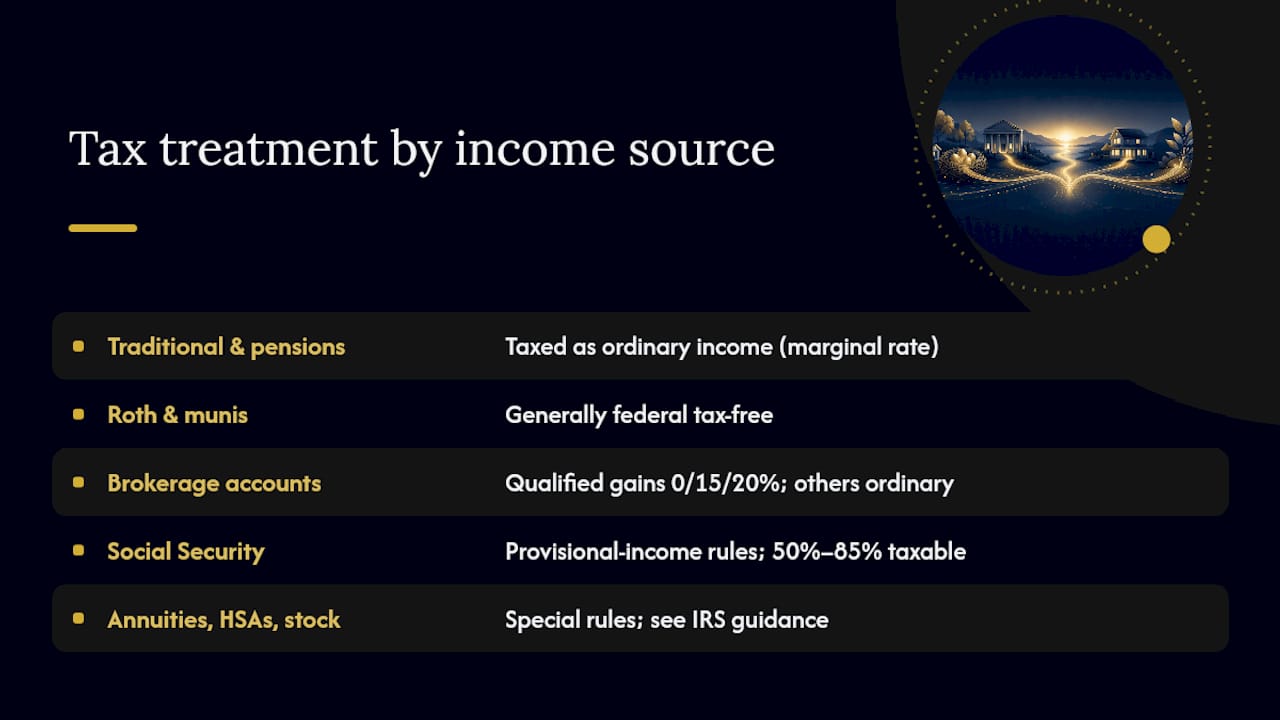
Traditional accounts and pensions. Withdrawals from a traditional 401(k), 403(b), or IRA count as ordinary income the year you take them, same as a pension check. There’s no special rate break here. Every dollar stacks on top of your other income and gets taxed at your marginal rate.
Roth accounts and municipal bonds. Qualified withdrawals from a Roth IRA or Roth 401(k) are generally free of federal tax, according to an explainer on how retirement sources are taxed. Municipal bond interest is typically exempt from federal tax too, though it can still count toward other calculations, like Social Security taxability.
Brokerage accounts. Qualified dividends and long-term capital gains use the separate 0/15/20% schedule instead of ordinary rates. Non-qualified dividends and short-term gains don’t get that break.
Social Security. This one trips up more retirees than any other line item. The IRS uses a “provisional income” formula, your adjusted gross income excluding Social Security, plus tax-exempt interest, plus half your Social Security benefit, to decide how much of your benefit gets taxed. Cross certain thresholds and up to 50% of your benefit becomes taxable; cross higher ones and it’s up to 85%, per IRS guidance on Social Security taxability.
Annuities, HSAs, and employer stock. Annuity income splits between principal and taxable earnings. Health Savings Accounts follow their own rules laid out in IRS Publication 969, and holding appreciated employer stock inside a 401(k) can qualify for special net unrealized appreciation treatment worth researching before you roll it over.
What Are the 2026 Federal Tax Brackets for Retirees?
Marginal brackets determine the rate on your next dollar of income, not your entire income. That distinction confuses more retirees than any other part of the tax code, according to the Tax Foundation’s explanation of progressive taxation.
Here’s how the 2026 ordinary income brackets break down by filing status:
| Rate | Single | Married Filing Jointly | Married Filing Separately | Head of Household |
|---|---|---|---|---|
| 10% | $0–$12,400 | $0–$24,800 | $0–$12,400 | $0–$17,700 |
| 12% | $12,400–$50,400 | $24,800–$100,800 | $12,400–$50,400 | $17,700–$67,450 |
| 22% | $50,400–$105,700 | $100,800–$211,400 | $50,400–$105,700 | $67,450–$105,700 |
| 24% | $105,700–$201,775 | $211,400–$403,550 | $105,700–$201,775 | $105,700–$201,750 |
| 32% | $201,775–$256,225 | $403,550–$512,450 | $201,775–$256,225 | $201,750–$256,200 |
| 35% | $256,225–$640,600 | $512,450–$768,700 | $256,225–$384,350 | $256,200–$640,600 |
| 37% | Over $640,600 | Over $768,700 | Over $384,350 | Over $640,600 |
Say you’re a single filer with $30,000 in Social Security (partly taxable) and other income already using up your standard deduction and the lower brackets. A $40,000 traditional IRA withdrawal doesn’t get taxed at one flat rate. The first chunk fills the 10% and 12% brackets, and only the portion above roughly $50,400 spills into the 22% bracket. Your effective rate, the average across all your income, ends up well below your marginal rate, the rate on that last dollar.
Long-term capital gains and qualified dividends sit on their own ladder: 0% up to roughly $48,350 (single) or $96,700 (MFJ) of taxable income, 15% above that up to about $533,400 (single), and 20% beyond it. Retirees with modest ordinary income sometimes realize gains at 0% federal tax entirely.
How Do Social Security and RMDs Push You Into a Higher Bracket?
RMDs and Social Security interact in a way that catches a lot of retirees off guard, usually around age 73.
- The provisional income test. Add your AGI (excluding Social Security), tax-exempt interest, and half your Social Security benefit. Cross $25,000 (single) or $32,000 (MFJ) and up to 50% of your benefit becomes taxable. Cross $34,000 (single) or $44,000 (MFJ) and up to 85% becomes taxable, per SSA’s benefits guide.
- RMD timing. Required Minimum Distributions from traditional accounts now generally start at age 73, and they’re taxed fully as ordinary income the year you take them.
- The stacking effect. An RMD doesn’t just add taxable income directly. It raises your provisional income too, which can drag more of your Social Security benefit into taxable territory at the same time.
Pro Tip: If you’re in your 60s and facing large RMDs later, running partial Roth conversions before age 73 can shrink the account balance that eventually forces those distributions.
Does Your State Tax Retirement Income Too?
Federal rules are only half the picture. State treatment of retirement income varies enormously, and it changes your real, all-in marginal rate.
- Several states, including Florida and Texas, levy no state income tax at all, so retirement withdrawals and Social Security pass through untouched at the state level.
- Some states tax Social Security benefits using their own income thresholds, separate from the federal formula.
- Others fully tax pension and IRA withdrawals as ordinary income, with no special retiree carve-out.
- A handful offer partial exemptions for pension income or age-based deductions that mirror the federal system but with different numbers.
If you’re weighing a move or splitting time between two states, confirm your domicile status, track days spent in each state, and check both states’ definitions of taxable retirement income before you file. State departments of revenue publish these rules directly, and they change more often than most retirees expect.
What Strategies Actually Lower Your Retirement Tax Bill?
The biggest lever most retirees ignore is sequencing, not just saving more.

Roth conversions. Converting traditional IRA dollars to a Roth means paying tax now, at today’s rate, to avoid tax later, potentially at a higher rate once RMDs and Social Security stack up. Partial conversions spread over several years can smooth your bracket instead of triggering one large tax hit.
Tax diversification. Holding a mix of taxable, tax-deferred, and tax-free accounts gives you control over which bucket you draw from each year, according to SmartAsset’s breakdown of account types. If you’re deciding how to prioritize contributions in the first place, this comparison of Roth versus traditional accounts walks through the trade-offs in more detail.
Qualified Charitable Distributions (QCDs). If you’re 70½ or older, sending IRA funds directly to charity satisfies your RMD without adding to taxable income at all.
Deductions. The standard deduction, plus the additional amount for taxpayers 65 and older, plus a new $6,000 senior deduction created by the One Big Beautiful Bill Act for 2026 (phasing out above $75,000 AGI for singles, $150,000 for joint filers), can meaningfully shrink taxable income, per research on 2026 retirement taxes.
- Watch the Net Investment Income Tax: a 3.8% surtax hits certain investment income once modified AGI passes $200,000 (single) or $250,000 (MFJ), detailed in IRS guidance on NIIT.
- Watch IRMAA: higher MAGI can raise your Medicare Part D and Part B premiums two years later, a cost that has nothing to do with income tax brackets but hits your budget just the same.
Pro Tip: Model a Roth conversion’s tax cost against the IRMAA surcharge it might trigger two years out. A conversion that looks smart on paper can backfire if it pushes you over a Medicare premium threshold.
Why Tax Diversification Matters More Than Total Savings
Professionals recommend holding taxable, tax-deferred, and tax-free accounts together because it gives you a choice every year: which bucket to tap based on your bracket at the time, according to Britannica’s overview of tax diversification. The order you draw from those buckets, not just how much you saved, often determines your lifetime tax bill.
Progressiveplanner’s Dual Purpose Retirement Strategy™ approaches this from a different angle. Instead of splitting savings across separate 401(k) and IRA buckets, it uses Indexed Universal Life (IUL) policies structured so the same dollar can support two tax-advantaged income streams, aiming to add a layer of tax-free access on top of traditional and Roth accounts.
This kind of structure tends to make the most sense for people who’ve maxed out traditional tax-advantaged space, want downside protection against market drops, and are comfortable working with a licensed advisor to model the trade-offs against a straightforward Roth conversion plan.
Whether it fits your situation depends on your goals, timeline, and risk tolerance, which is exactly why a personalized consultation matters more than a general rule here.
How Do You Estimate Your Own Retirement Tax Bill?
Run through these five steps with your own numbers:
- List every income source: IRA/401(k) withdrawals, pension checks, taxable interest and dividends, and your gross Social Security benefit.
- Calculate provisional income to estimate how much of your Social Security becomes taxable.
- Subtract deductions: standard deduction, the extra amount for age 65+, and the 2026 senior deduction if you qualify.
- Apply the 2026 brackets to your remaining taxable income, using the LTCG schedule separately for qualified dividends and long-term gains, and add NIIT if your MAGI clears the threshold.
- Gather your documents: SSA benefit statement, all 1099s, and account balance estimates, then confirm your final numbers with a CPA or a retirement tax calculator before filing.
A Planner’s Take on Bracket Management
Predictability beats optimization. Chasing the perfect Roth conversion amount matters less than avoiding a surprise RMD spike that shoves you into a higher bracket for a single bad year. Start modeling scenarios in your late 50s, not your 70s, and loop in a licensed advisor once your accounts get complex enough that a spreadsheet stops being enough.
What a Consultation With Progressiveplanner Looks Like
Progressiveplanner is built for the exact planning gap this article covers: figuring out which account to draw from, in what order, and whether a Roth conversion or an alternative structure actually lowers your lifetime tax bill. A consultation walks through withdrawal sequencing, models partial Roth conversions against your projected RMDs, and reviews whether an Indexed Universal Life policy fits your goals as a second tax-advantaged income stream.

IUL is an insurance-based product, not a retirement account, and it isn’t the right fit for everyone. That’s exactly why the review is free and personalized rather than a generic recommendation. If you want a clear picture of how your current accounts will actually get taxed in retirement, start a retirement income review with Progressiveplanner.
Frequently Asked Questions
What are the retirement tax brackets for 2026?
Is Social Security taxed the same as other retirement income? No. Social Security uses a separate provisional income formula.
Do RMDs count as taxable income? Yes. Required Minimum Distributions from traditional 401(k)s and IRAs are taxed fully as ordinary income in the year you receive them, and they can also increase how much of your Social Security benefit gets taxed.
Can moving to a different state lower my retirement taxes? It can, since some states don’t tax retirement income or Social Security at all. Confirm your new state’s specific rules on pensions, withdrawals, and residency requirements before assuming a move will save you money.
What is tax diversification in retirement? It means holding a mix of taxable, tax-deferred, and tax-free accounts so you can choose which bucket to draw from each year based on your tax bracket, giving you more control over your total tax bill.
This article is general information, not a substitute for advice from a qualified financial advisor. Consult a qualified financial professional about your own circumstances before acting on anything here.