
IUL as a Bond Replacement Strategy for Retirement Savers

Yes, an Indexed Universal Life (IUL) policy can serve the role bonds play in a retirement plan, but only when it’s structured correctly, funded generously, and held for the long term. This is not a universal swap. For the right person, though, IUL delivers what bonds are supposed to deliver: a buffer against market losses, a source of tax-advantaged liquidity in down years, and a counterweight to equity volatility. The wrong person will pay high fees for a policy that underperforms a simple bond fund.
Before going further, schedule a retirement income review to model how an IUL compares to your current bond allocation. Three things drive the case:
- Stability and buffer role: IUL cash value earns index-linked credits with a 0% floor, so a down market year doesn’t reduce your cash value the way a bond fund can drop in a rising-rate environment.
- Tax treatment: Policy loans are generally not taxable while the policy stays in force, unlike required minimum distributions (RMDs) from a 401(k) or IRA under IRS rules.
- Timeline: A 2025 Ernst & Young analysis found that integrating insurance products like IUL into retirement portfolios can materially improve modeled income outcomes. The catch: you need 8–12 years for the strategy to reach break-even. Progressiveplanner’s Dual Purpose Retirement Strategy™ is built around exactly this framework.
Key Takeaways
An IUL policy can replace the buffer and tax-diversification role of bonds in a retirement plan, but only when funded correctly and held for at least 8–12 years.
| Point | Details |
|---|---|
| IUL replaces bond function, not yield | IUL provides a downside buffer and tax-free liquidity, not a coupon payment. |
| Suitability requires a long runway | The 8–12 year break-even window makes IUL unsuitable for anyone within five years of retirement. |
| Funding discipline is non-negotiable | Underfunding and unmanaged loans are the primary causes of policy failure, not market losses. |
| EY 2025 supports integration | Ernst & Young’s 2025 analysis found integrated IUL allocations improved modeled retirement income in many tested scenarios. |
| Progressiveplanner’s approach | The Dual Purpose Retirement Strategy™ applies IUL as a tax-free buffer layer alongside a 401(k)/IRA to create two income streams from the same savings. |
Table of Contents
- What is a bond replacement strategy using IUL?
- Who should consider using IUL as a bond replacement?
- What are the real trade-offs versus holding bonds?
- How do you implement an IUL bond-replacement strategy?
- How Progressiveplanner’s Dual Purpose Retirement Strategy™ works
- What does the buffer effect actually look like?
- When Progressiveplanner recommends IUL and when it doesn’t
- Progressiveplanner’s Dual Purpose Retirement Review
- Sources
What is a bond replacement strategy using IUL?
The role bonds play in a retirement portfolio is specific: they provide stability when equities fall, generate income, and give you something to sell or draw from without locking in equity losses. IUL doesn’t replace bonds by paying a coupon. It replaces the function bonds serve.
Here’s how the mechanics work. An IUL policy builds cash value over time. That asymmetry is the buffer.
When markets fall and you need retirement income, you take a policy loan against the cash value rather than selling equities at a loss. That loan is generally not treated as taxable income as long as the policy remains in force and doesn’t lapse. Your equities stay invested and recover. This is the sequence-of-returns protection that bonds are supposed to provide, and according to Ameritas, IUL cash value functions as exactly this kind of liquidity buffer within an integrated retirement strategy.
A few contract features matter enormously:
- Cost of insurance (COI): Rises with age; must be modeled over the full policy life.
- Caps and participation rates: Determine how much index upside you actually capture.
- Spreads: Some carriers deduct a spread from index gains before crediting your account.
- Surrender charges: Typically apply for the first 10–15 years; early exit is expensive.
- MEC rules: Overfund too aggressively and the IRS reclassifies the policy as a Modified Endowment Contract, eliminating the tax-free loan advantage.
Pro Tip: Fund the policy above the minimum premium from day one. Underfunding is the most common reason IUL policies fail to build meaningful cash value. Work with your advisor to find the maximum non-MEC funding level and stay as close to it as possible.
Who should consider using IUL as a bond replacement?
Not everyone qualifies, and not everyone who qualifies should do this. Use this checklist honestly.
You’re likely a good fit if:
- You’re between ages 40 and 60 with at least 8–12 years before you need to draw from the policy.
- You already contribute enough to your 401(k) to capture any employer match.
- You have a genuine need for permanent life insurance coverage.
- You can fund the policy above the minimum premium without financial strain.
- You’re in good enough health to qualify for standard or better underwriting rates.
- Your tax situation makes tax-free retirement income meaningful (high earner, high future RMD exposure).
Red flags that suggest IUL is the wrong tool:
- You need access to the money within five years.
- You have health conditions that will push premiums into a range that makes the math unworkable.
- Your primary goal is yield, not a buffer. IUL is not a bond substitute for income generation.
- You’re unwilling to commit to annual policy reviews and ongoing funding discipline.
Questions to ask any advisor before signing:
- What is the expected break-even year for this specific design?
- What is the maximum non-MEC funding level for this policy?
- How does the COI change at age 70, 75, and 80?
- What cap and participation rate does this carrier guarantee as a minimum?
- What happens to the policy if I miss two years of premium payments?
- How does this design compare to simply holding an intermediate bond fund in a Roth IRA?
- What is the carrier’s financial strength rating (AM Best, Moody’s)?
- Has this illustration been run at a conservative index crediting rate (e.g., 5–6%)?
Underwriting matters more than most people expect. A 55-year-old in excellent health pays dramatically different premiums than a 55-year-old with managed diabetes. Age and health together determine whether the COI load makes the strategy viable or not.
What are the real trade-offs versus holding bonds?
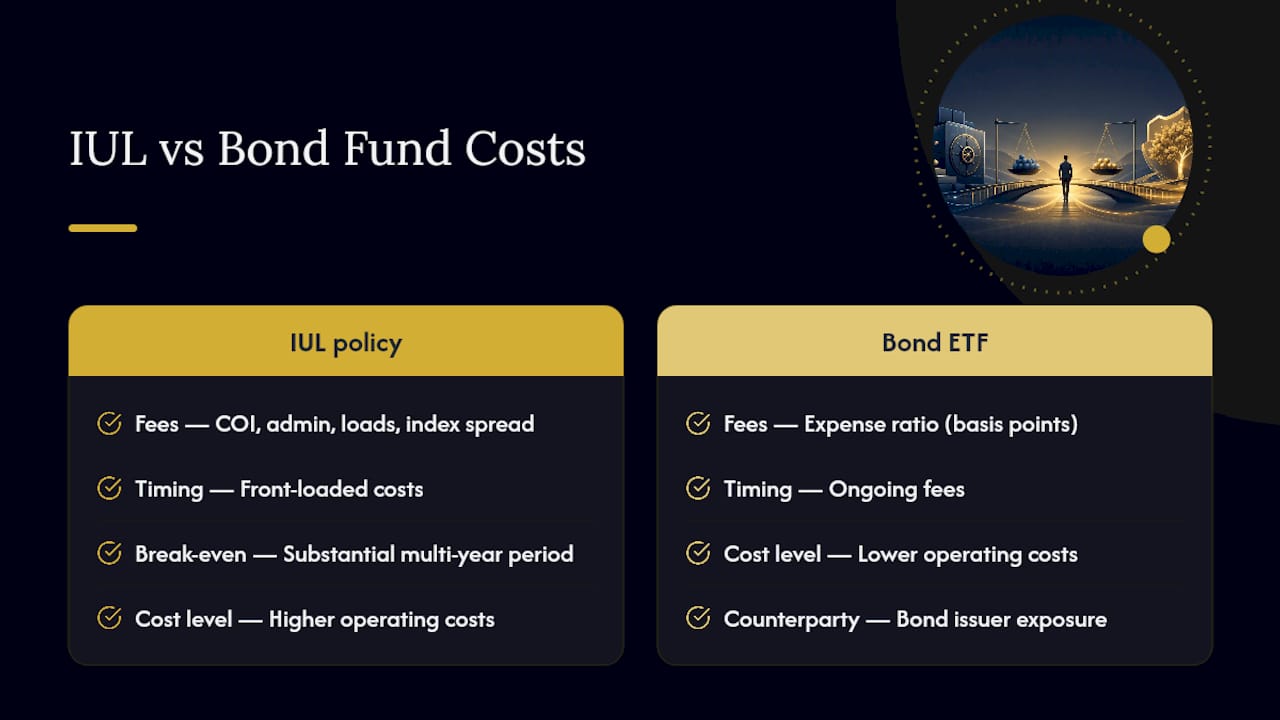
IUL costs more to operate than a bond fund. That’s the honest starting point. A bond ETF charges basis points. An IUL policy charges COI, administrative fees, premium loads, and potentially a spread on index credits. Those costs are front-loaded, which is why most IUL policies reach break-even after a substantial multi-year period.
The upside is capped. In a strong equity year, a bond fund holder doesn’t capture equity gains either, so this isn’t unique to IUL. But the cap means you’re trading potential upside for downside protection, and that trade only makes sense if the downside protection is actually used.
Insurer credit risk is real. When you hold an IUL policy, you’re exposed to the financial strength of the insurance company, not a bond issuer. Check AM Best ratings. A carrier rated A or better is the standard minimum for a long-term commitment like this.
Warning: Unmanaged policy loans are the most common cause of IUL policy lapse. If loan interest accrues faster than cash value grows, the policy can collapse, triggering a taxable event on all gains. Annual reviews are not optional.
A 2025 Ernst & Young analysis found that integrated allocations combining IUL with traditional investments improved modeled retirement income outcomes in many tested scenarios, allowing a reduction in traditional bond exposure while maintaining or improving portfolio stability. That’s meaningful evidence, but the key phrase is “under specific allocations.” Design matters.
How do you implement an IUL bond-replacement strategy?
Follow these steps in order. Skipping the early ones is how people end up with a policy that doesn’t serve its purpose.
- Model your current retirement income plan. Map your projected 401(k)/IRA balances, Social Security timing, and estimated withdrawal needs. Identify your sequence-of-returns exposure.
- Set clear policy objectives. Decide whether the IUL layer is primarily a volatility buffer, a tax-free income source, or both. This shapes the design.
- Design for maximum non-MEC funding. Work with an advisor to calculate the maximum premium you can pay without triggering MEC status. Fund as close to that ceiling as your cash flow allows.
- Select a carrier and run illustrations. Compare at least two carriers. Run illustrations at both the illustrated rate and a conservative 5–6% crediting assumption. The gap between those two numbers tells you the risk.
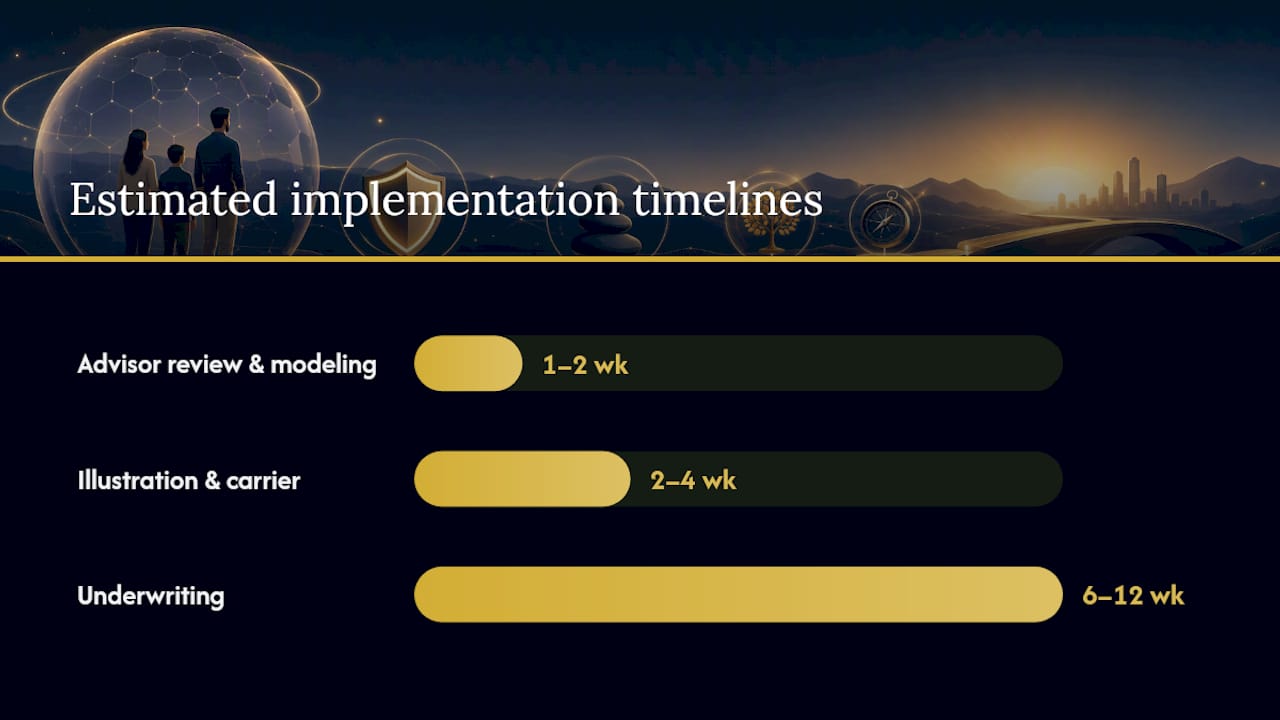
- Apply and complete underwriting. Expect 6–12 weeks from application to policy issue. Gather current account statements, tax returns, and a clear picture of your withdrawal timeline before the first advisor meeting.
- Fund consistently and review annually. The policy needs annual reviews to catch COI increases, loan balance drift, and any changes in your retirement timeline.
Estimated milestones: advisor review and income modeling takes 1–2 weeks; illustration and carrier selection, 2–4 weeks; underwriting, 6–12 weeks; break-even expectation, 8–12 years.
Pro Tip: Ask your advisor to run a “lapse stress test” — a scenario where index credits average 4% for five consecutive years. If the policy lapses under that scenario at your planned funding level, the design needs to change before you sign.
For a broader view of how IUL fits within a diversified retirement portfolio, the three-bucket framework (taxable, tax-deferred, tax-free) is the standard context.
How Progressiveplanner’s Dual Purpose Retirement Strategy™ works
Progressiveplanner built its Dual Purpose Retirement Strategy™ around a specific insight: the same dollar can serve two functions simultaneously. Rather than parking savings in a single tax-deferred bucket like a 401(k), the strategy adds an IUL layer that creates a second, tax-free income stream from the same savings base.
The strategy addresses four retirement risks at once:
- Sequence-of-returns risk: IUL cash value acts as the draw source in down market years, leaving equities untouched to recover.
- Tax risk: Policy loans are generally not taxable, reducing dependence on RMD-driven taxable distributions in retirement.
- Volatility risk: The 0% floor means the IUL layer doesn’t participate in market losses.
- Legacy risk: The death benefit provides a tax-efficient transfer to beneficiaries.
A Dual Purpose Retirement Review includes modeled income comparisons between a traditional allocation and an integrated IUL strategy, policy design options from multiple carriers, and a funding schedule tailored to your timeline and tax situation.
Disclosure: Progressiveplanner provides advisory services and places Indexed Universal Life insurance policies as part of strategy implementation. Compensation may include commissions from insurance carriers.
What does the buffer effect actually look like?
Consider a simplified scenario. A retiree holds a $600,000 equity portfolio and needs $30,000 per year in income.
The difference compounds. The portfolio that avoided the forced sale at the bottom has more capital working in the recovery. Over a 20-year retirement, that gap widens significantly.
The EY 2025 analysis supports this framing directly: integrated strategies that included insurance products as part of the fixed-income allocation produced materially better modeled outcomes in many tested scenarios.
Important: These projections depend entirely on policy design, funding consistency, and carrier assumptions. An underfunded or poorly designed policy will not deliver this buffer. Run your own modeled illustration with a licensed advisor before drawing any conclusions.
When Progressiveplanner recommends IUL and when it doesn’t
The right client for this strategy has a long runway, a genuine insurance need, and the cash flow to fund the policy properly. If you have an employer match you’re not fully capturing, do that first. IUL works as a supplemental bond-replacement layer, not a substitute for free money.
If you’re within five years of retirement, the math rarely works. The front-loaded costs and 8–12 year break-even window mean you’d be drawing from a policy that hasn’t matured. That’s the wrong tool for the job.
The clients who benefit most are typically in their mid-40s to mid-50s, already maxing their 401(k), facing meaningful future RMD exposure, and looking for a tax-free income source that doesn’t move with the market. For that profile, a well-designed IUL policy, reviewed annually and funded consistently, can genuinely replace the bond allocation’s function inside a retirement plan.
Consult a licensed advisor and run modeled illustrations before committing any funds. The illustration is the only honest way to see whether the numbers work for your specific situation.
Progressiveplanner’s Dual Purpose Retirement Review
Retirement income planning works best when someone models the actual numbers for your situation, not a generic scenario. Progressiveplanner’s Dual Purpose Retirement Review gives you a side-by-side comparison of your current retirement income projection versus an integrated IUL strategy, policy design options from multiple carriers, and a funding schedule built around your timeline.

After a discovery call, you’ll receive a modeled income comparison, a recommended policy design, and a clear picture of what the break-even timeline looks like for your age and health profile. The review is designed to show you the numbers before you commit to anything.
Progressiveplanner provides advisory services and places Indexed Universal Life insurance policies as part of strategy implementation. Compensation may include commissions from insurance carriers.
Schedule your Dual Purpose Retirement Review and see what the integrated strategy looks like for your specific retirement plan.
Sources
For personalized modeling and policy design, consult a licensed insurance and financial advisor. General information in this article does not constitute financial, tax, or legal advice. Verify current IRS rules and carrier terms with a qualified professional before implementing any strategy.