
Provisional Income and Social Security: What Retirees Need to Know

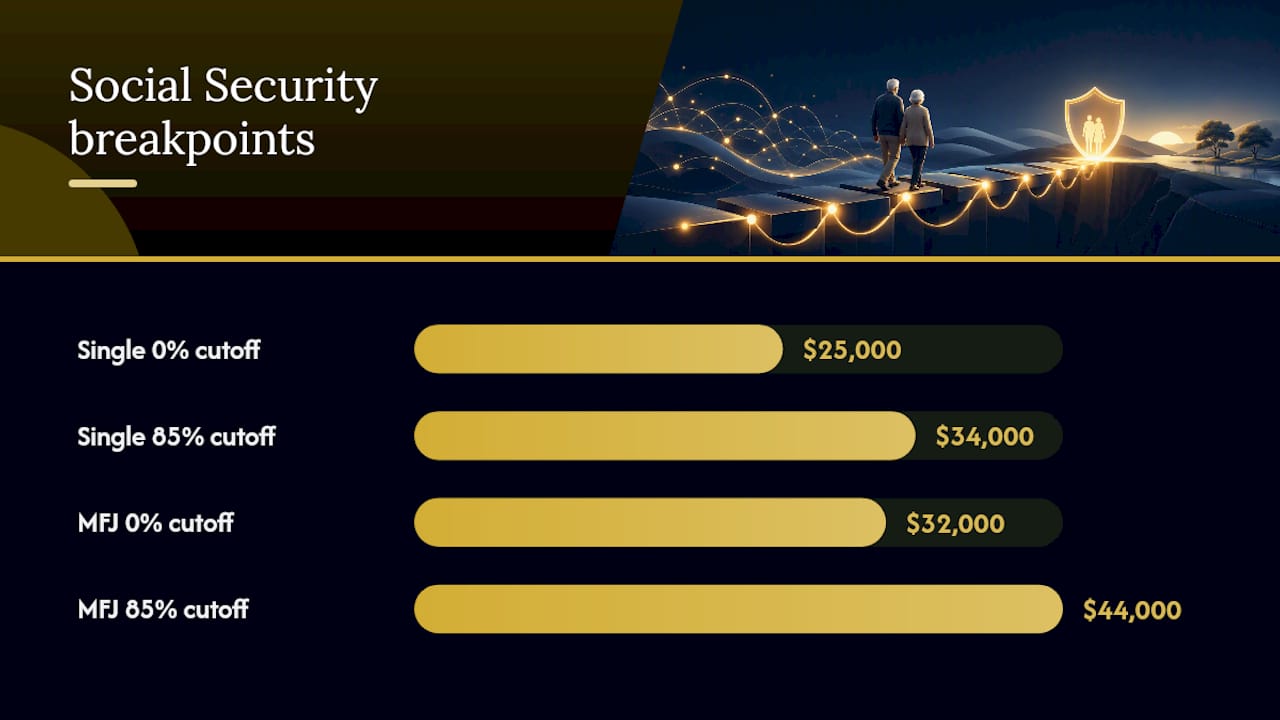
Provisional income is the IRS’s measuring stick for deciding how much of your Social Security benefit gets taxed. For 2026, single filers with provisional income below $25,000 owe nothing on their benefits. Joint filers use $32,000 and $44,000 as their cutoffs. The IRS covers the mechanics in Publication 915, and the Social Security Administration handles the separate earnings test rules that often get confused with this calculation.
Key Takeaways
Provisional income determines how much of your Social Security benefit is taxable, and the fixed thresholds mean more retirees cross into taxable territory every year without any change in their real purchasing power.
| Point | Details |
|---|---|
| The formula | AGI + tax-exempt interest + 50% of Social Security benefits = provisional income. |
| 2026 thresholds | Single filers: $25,000 (50% tier) and $34,000 (85% tier); joint filers: $32,000 and $44,000. |
| Muni bond surprise | Tax-exempt municipal bond interest is excluded from AGI but still counted in provisional income. |
| Filing separately | Married filing separately with a spouse you lived with sets your base amount to $0, making benefits taxable from the first dollar. |
| Progressiveplanner | A Progressiveplanner retirement income review models Roth conversion timing and RMD strategies to reduce provisional income across multiple years. |
Table of Contents
- How is provisional income for Social Security calculated?
- What are the 2026 thresholds for taxable Social Security benefits?
- Worked examples: seeing the math in action
- How does provisional income differ from the Social Security earnings test?
- Practical strategies to reduce taxable Social Security benefits
- What legislation could change provisional income rules?
- How we showed our math and sources
- Who feels the provisional income thresholds most?
- How filing status shapes your provisional income exposure
- The case for modeling before you assume
- A planner’s perspective on DIY vs. professional modeling
- Progressiveplanner can model your provisional income scenarios
- Sources
How is provisional income for Social Security calculated?
The provisional income formula is defined precisely under IRC §86:
It functions as a trigger, not a separate tax. Once your provisional income crosses a threshold, a portion of your Social Security benefit gets folded into ordinary taxable income.
What goes into AGI for this calculation
Your AGI for provisional income purposes includes everything that normally appears on Form 1040 before deductions:
- Wages and self-employment income
- Taxable pension and annuity distributions (including 401(k) and traditional IRA withdrawals)
- Dividends, capital gains, and taxable interest
- Rental income and business income
- Required Minimum Distributions (RMDs) from traditional retirement accounts
What gets added back on top of AGI
- Tax-exempt municipal bond interest. This is the most common surprise. Municipal bond interest never appears in your AGI, yet the IRS adds it back for provisional income purposes. A retiree holding $200,000 in muni bonds earning 4% adds $8,000 to their provisional income total even though that interest is federally tax-free.
- 50% of your gross Social Security benefit. Use the total benefit shown in Box 5 of your Form SSA-1099, not the net amount after Medicare premium deductions.
What does NOT count toward provisional income
- Supplemental Security Income (SSI)
- Most veterans’ benefits
- Roth IRA and Roth 401(k) distributions (qualified distributions are excluded from AGI and carry no tax-exempt interest component)
- Tax-deferred rollover amounts that are not yet distributed
Worksheet steps matching Publication 915
- Find your total Social Security benefit from Box 5 of Form SSA-1099.
- Multiply that figure by 50%.
- Add your AGI (Form 1040, line 11 before the Social Security deduction).
- Add any tax-exempt interest (Form 1040, line 2a).
- The total is your provisional income. Compare it to the thresholds in the next section.
- Report total benefits on Form 1040, line 6a; report the taxable portion on line 6b.
What are the 2026 thresholds for taxable Social Security benefits?
The statutory two-threshold structure has not been indexed for inflation since Congress set it in 1983 and 1993. That means more retirees cross into taxable territory every year as incomes rise.
| Filing Status | 0% Taxable (Below) | Up to 50% Taxable | Up to 85% Taxable (Above) |
|---|---|---|---|
| Single / Head of Household / Qualifying Surviving Spouse | $25,000 | $25,000–$34,000 | $34,000 |
| Married Filing Jointly | $32,000 | $32,000–$44,000 | $44,000 |
| Married Filing Separately | $0 | $0 | Any amount |
The married filing separately trap. If you file separately from your spouse and lived with them at any point during the year, your base amount drops to $0. That means essentially all of your Social Security benefit is potentially taxable from the first dollar. There is no lower bracket protection. This filing status almost always produces a worse outcome for Social Security taxation than filing jointly.
The actual taxable amount is the lesser of two calculations, both described in Publication 915 worksheets.
Worked examples: seeing the math in action
These three scenarios use a hypothetical retiree receiving $20,000 per year in Social Security benefits.
Scenario A: Below the threshold (single filer)
- AGI: $14,000 (small pension)
- Tax-exempt interest: $0
- 50% of Social Security: $10,000
- Provisional income: $24,000
Result: $24,000 is below $25,000. Zero dollars of Social Security is taxable. The full $20,000 benefit is received tax-free.
Scenario B: In the 50% zone (single filer)
- AGI: $20,000 (IRA distribution)
- Tax-exempt interest: $2,000 (muni bonds)
- 50% of Social Security: $10,000
- Provisional income: $32,000
Result: $32,000 falls between $25,000 and $34,000.
Pro Tip: In Scenario B, a $2,000 reduction in the IRA distribution would drop provisional income to $30,000 and reduce the taxable Social Security amount to $2,500, saving about $110 in federal tax. Small timing moves matter more than most retirees realize.
Scenario C: In the 85% zone (single filer)
- AGI: $38,000 (pension + IRA withdrawals)
- Tax-exempt interest: $3,000
- 50% of Social Security: $10,000
- Provisional income: $51,000
Result: $51,000 exceeds $34,000. Crossing from Scenario B into Scenario C by earning just $2,000 more in ordinary income can trigger thousands of dollars in additional tax, because the extra income both raises AGI and pulls more Social Security into the taxable column simultaneously.
How does provisional income differ from the Social Security earnings test?
These two rules are frequently confused, and mixing them up leads to real planning mistakes.
The earnings test is an SSA rule that can temporarily reduce your monthly benefit payments if you collect Social Security before your full retirement age (FRA) and continue working. For 2026, the SSA sets two exempt amounts: $24,480 for most beneficiaries below FRA, and $65,160 for those reaching FRA during the year. Earn above $24,480 and the SSA withholds $1 of benefit for every $2 of excess earnings. In the year you reach FRA, the withholding rate drops to $1 for every $3 above $65,160. Once you hit FRA, the earnings test disappears entirely.
Provisional income, by contrast, is a tax calculation. It has nothing to do with whether the SSA sends you a check. It determines how much of the benefit you do receive gets reported as taxable income on your federal return.
| Rule | What It Measures | Income That Counts | Consequence |
|---|---|---|---|
| Earnings test | Wages and net self-employment only | No investment income, no pension, no IRA distributions | Temporary benefit withholding; credited back at FRA |
| Provisional income | AGI + tax-exempt interest + 50% of benefits | All AGI sources plus muni bond interest | Portion of benefits becomes taxable on Form 1040 |

A retired teacher drawing a pension, muni bond interest, and Social Security faces zero earnings-test exposure (no wages) but could easily have high provisional income. The two rules operate on completely different inputs and produce completely different outcomes. The SSA’s publication on working in retirement explains how withheld benefits are credited and later recalculated after FRA, which is worth reading if you are still working while collecting.
Practical strategies to reduce taxable Social Security benefits
Lowering provisional income is the lever. These strategies each work differently, and most involve trade-offs worth modeling before acting.
-
Roth conversions in low-income years. Roth distributions do not count toward provisional income. Converting traditional IRA funds to a Roth in years when your income is low (say, between retirement and when RMDs begin) raises your AGI in the conversion year but can permanently reduce future provisional income. The trade-off: you pay ordinary income tax on the converted amount now. The payoff: future withdrawals are tax-free and invisible to the provisional income formula.
-
Delay Social Security to reduce the 50% add-back. The longer you wait to claim (up to age 70), the higher your monthly benefit, but you also add more to the 50% component of the formula. Counterintuitively, delaying can push some retirees into a higher provisional income bracket. Run the numbers both ways before assuming delay is always optimal.
-
Manage RMD timing carefully. RMDs from traditional IRAs and 401(k)s flow directly into AGI and therefore into provisional income. Strategies like Qualified Charitable Distributions (QCDs) allow you to satisfy up to $105,000 of your RMD by donating directly to charity, keeping that amount out of AGI entirely.
-
Tax-loss harvesting. Realized capital losses offset capital gains in AGI. In years when you have embedded losses in a taxable brokerage account, harvesting them can reduce AGI and, in turn, provisional income.
-
Municipal bonds: use with awareness. Muni bond interest is federally tax-exempt but still counted in provisional income. Holding munis in a year when you are already above the 85% threshold adds no additional tax on Social Security, but holding them when you are near the $25,000 or $32,000 lower threshold can push you into taxable territory. The tax benefit of munis is real but narrower than many retirees assume.
-
Withholding and estimated taxes. Once a portion of your Social Security becomes taxable, you can request federal withholding directly from your benefit by filing Form W-4V, or make quarterly estimated tax payments. Failing to do either can result in underpayment penalties.
Pro Tip: The IRS offers a free withholding estimator at irs.gov that can help you calculate whether you need to adjust withholding or make estimated payments once you know your provisional income.
When multiple income streams interact (pension, RMDs, part-time work, investment income, Social Security), the interactions compound quickly. That is when a tax professional or a retirement income planner becomes worth the cost.
What legislation could change provisional income rules?
In real terms, that means tens of millions of retirees now pay tax on benefits that Congress originally intended to protect.
Several proposals have circulated in recent Congressional sessions. The Senior Citizens Tax Elimination Act would remove federal income tax on Social Security benefits entirely. Neither has passed as of 2026.
What the law currently says vs. what proposals would change: Under current law (IRC §86), the $25,000/$34,000 thresholds for single filers and $32,000/$44,000 for joint filers remain fixed. Pending bills would either raise those thresholds substantially or eliminate the tax on benefits altogether. No change takes effect until legislation is signed into law. Readers who want to track these bills can monitor summaries at Congress.gov.
The practical implication: plan under current law. If thresholds rise or the tax is eliminated, that is a future benefit, not something to count on in a retirement income model today.
How we showed our math and sources
Every threshold and formula in this article comes from primary government sources, verified for 2026.
- IRS Publication 915 — (Social Security and Equivalent Railroad Retirement Benefits): the authoritative worksheet for computing taxable Social Security benefits. Download it at irs.gov.
- Form SSA-1099 — (Social Security Benefit Statement): mailed each January; Box 5 shows your net benefit for the prior year. Use this figure in the provisional income formula.
State income tax is excluded. Actual tax owed depends on deductions, credits, and state rules. Use the Publication 915 worksheet or a tax professional to run your specific numbers.
The SSA offers a Benefits Eligibility Screening Tool and online calculators at ssa.gov for estimating benefits. The IRS withholding estimator at irs.gov can help you calculate whether estimated payments are needed once you know your taxable benefit amount.
Who feels the provisional income thresholds most?
The fixed thresholds create a bracket-creep problem that falls unevenly across retirees. A couple who retired in 1993 with $32,000 in combined income was right at the joint filer lower threshold. The thresholds have never moved.
Middle-income retirees with a mix of traditional IRA income, a modest pension, and Social Security are the most exposed group. They typically have enough income to cross the $25,000 or $32,000 lower threshold but not enough to benefit from sophisticated tax planning. Very low-income retirees stay below the lower threshold entirely.
Near-retirees in their late 50s and early 60s face a planning window that older retirees no longer have. Converting traditional IRA funds to Roth accounts before Social Security begins can permanently reduce future provisional income. Once RMDs start at age 73 (under current law), the mandatory distributions lock in a higher AGI floor that is difficult to reduce.
Widows and widowers face a specific cliff. A surviving spouse who previously filed jointly suddenly files as single, cutting the lower threshold from $32,000 to $25,000. The same income that produced zero taxable Social Security under joint filing can produce a significant taxable amount the following year.
How filing status shapes your provisional income exposure
Filing status affects provisional income in ways that go beyond simply using different threshold numbers.
Married filing jointly uses the $32,000 and $44,000 thresholds and combines both spouses’ incomes and Social Security benefits into a single provisional income calculation. One spouse’s high income can push the other’s benefits into taxable territory even if the second spouse would have been below the threshold filing alone.
Single filers (including divorced individuals and those who have never married) use $25,000 and $34,000. Head of household and qualifying surviving spouse filers use the same thresholds as single filers for provisional income purposes.
Married filing separately is the most punishing status. If you lived with your spouse at any point during the tax year, your base amount is $0. The entire provisional income formula still applies, but with no lower threshold protecting you. Even a small amount of provisional income can make a portion of your benefits taxable. The IRS designed this rule specifically to prevent spouses from splitting income to game the thresholds.
One narrow exception: if you lived apart from your spouse for the entire tax year and file separately, you may qualify to use the single-filer thresholds. This applies to couples who are legally married but maintain entirely separate households year-round. Confirm this with a tax professional before relying on it, since the rules around “lived apart” are strict.
The case for modeling before you assume
A planner’s perspective on DIY vs. professional modeling
A single-page worksheet from Publication 915 is genuinely sufficient for a retiree with one income source, one Social Security benefit, and no Roth conversion plans. Run the numbers, compare to the thresholds, done.
The calculation gets complicated fast when you add a pension, a part-time consulting income, RMDs from multiple accounts, a spouse’s benefit, and a potential Roth conversion on top. At that point, a spreadsheet can tell you where you stand today but not what a $15,000 Roth conversion does to your provisional income in year three when RMDs begin. That requires modeling across multiple years simultaneously, which is where professional planning earns its cost.
The specific moves worth modeling with a professional: Roth conversion ladders timed between retirement and RMD onset, QCD strategies to reduce RMD-driven AGI, and Social Security claiming age decisions that interact with provisional income. These are not one-year decisions. They compound, and getting them wrong in year one can lock in a higher tax burden for a decade.
Progressiveplanner can model your provisional income scenarios
Most retirees discover their Social Security tax exposure only when the tax bill arrives. Progressiveplanner’s Dual Purpose Retirement Strategy™ is built specifically to show you the numbers before that happens.

A Progressiveplanner consultation runs your provisional income across multiple scenarios: different Roth conversion amounts, different Social Security claiming ages, different RMD timing strategies. You see the projected taxable benefit amount and the estimated tax impact side by side, not as a single-year snapshot but as a multi-year projection. The strategy incorporates Indexed Universal Life (IUL) policies alongside your existing accounts to create two tax-advantaged income streams from the same savings, which can reduce the AGI that drives provisional income in later years.
This is a fee-transparent, insurance-based planning model. Schedule a free retirement income review at Progressiveplanner to see how your current income mix affects your Social Security tax exposure and what a restructured strategy could look like.
Sources
The IRS and SSA are the only authoritative sources for provisional income thresholds and Social Security reporting rules. Consumer guides and financial media are useful for examples, but always verify figures against the primary documents below.
- Provisional Taxes: What They Are and How They Work
- Social Security Income | Internal Revenue Service
- Congress
- Benefits Planner: Retirement | Receiving Benefits While Working | SSA
This article provides general educational information about federal tax rules and is not a substitute for advice from a licensed tax professional or financial advisor. Tax laws can change; confirm current thresholds and rules with the IRS, SSA, or a qualified professional before making financial decisions.