
Estate Tax Exemption 2026: What You Need to Know

The federal estate and gift tax basic exclusion amount is $15,000,000 per person for 2026, effective for deaths and gifts after December 31, 2025. That figure, confirmed by the IRS estate tax guidance, is the highest in U.S. history. If your taxable estate or cumulative lifetime gifts are approaching that threshold, now is the time to sit down with an estate attorney or tax advisor.
Key Takeaways
The 2026 federal estate tax basic exclusion is $15,000,000 per person, the highest in U.S. history, and married couples can combine exemptions through portability to shelter up to $30,000,000.
| Point | Details |
|---|---|
| 2026 exemption amount | $15,000,000 per person; set by Public Law 119-21 and indexed for inflation going forward. |
| Portability for couples | A surviving spouse can claim unused exemption, creating a combined $30,000,000 shield. |
| Annual gift exclusion | $19,000 per recipient in 2026; married couples can give $38,000 per recipient using gift-splitting. |
| State tax exposure | 12 states plus D.C. have separate estate taxes with much lower exemptions — federal clearance does not mean state clearance. |
| Next step | Consult an estate attorney or tax advisor, especially if you own property in multiple states or have not reviewed your plan recently. |
Table of Contents
- What changed for 2026 and why the sunset never happened
- How the estate and gift exclusion mechanics actually work
- When you need to file Form 706 and how portability works
- Why state estate taxes still matter even below the federal threshold
- Practical steps to take now with the 2026 exemption
- A brief history of the federal basic exclusion amount (2011–2026)
- A word from Progressiveplanner on planning in 2026
- Sources
What changed for 2026 and why the sunset never happened
Many estate planners spent years warning clients about the “TCJA sunset” — the scheduled drop that would have cut the exemption roughly in half at the start of 2026. That drop never happened.
The One Big Beautiful Bill Act, enacted as Public Law 119-21, amended IRC § 2010©(3) to set the basic exclusion at $15,000,000 for calendar year 2026 and indexed it for inflation going forward. In plain terms, Congress permanently replaced the sunset with a higher, growing number.
Key facts about the legislative change:
- The prior sunset is gone. The Tax Cuts and Jobs Act of 2017 had set a temporary doubling of the exemption that was scheduled to expire after 2025. Public Law 119-21 eliminated that expiration.
- Inflation indexing continues. The $15,000,000 baseline will adjust upward in future years based on cost-of-living calculations, so the IRS “What’s New” estate and gift tax page is the right place to confirm the exact figure each year.
- Effective date is January 1, 2026. The new amount applies to gifts made and deaths occurring after December 31, 2025.
- Political risk remains real. A future Congress could still change rates or exemptions, which is why some advisors still recommend acting sooner rather than later.
How the estate and gift exclusion mechanics actually work
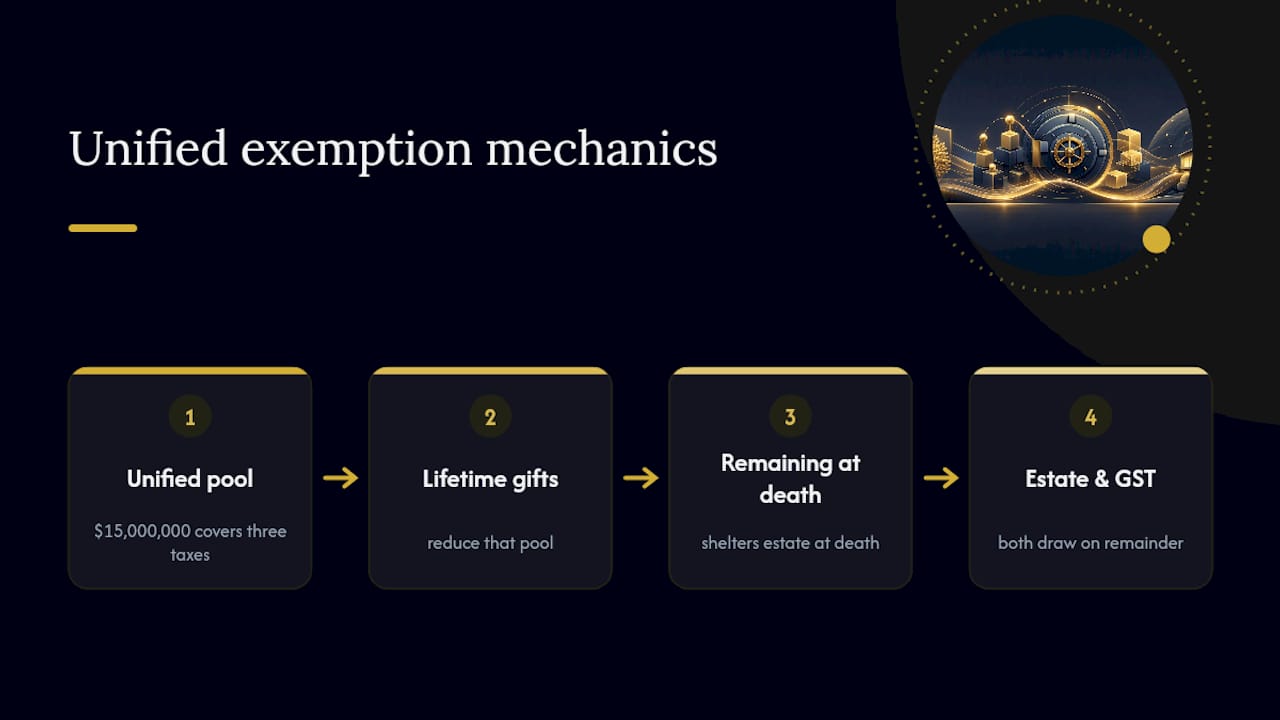
The federal exemption is “unified,” meaning the same $15,000,000 pool covers three separate transfer taxes: the estate tax, the lifetime gift tax, and the generation-skipping transfer (GST) tax. Every taxable gift you make during life reduces what’s left to shelter your estate at death.
Portability and the married-couple advantage. When a spouse dies without using their full exemption, the surviving spouse can claim the unused portion through a portability election. That creates a combined shield of up to $30,000,000 for married couples, as Fidelity explains. The math is straightforward: Spouse A dies with a — estate, using — of their $15,000,000 exemption. The surviving Spouse B can add the unused $10,000,000 to their own $15,000,000, for a total of $25,000,000 in sheltering capacity.
Annual gift tax exclusion. Separate from the lifetime exemption, you can give $19,000 per recipient per year in 2026 without filing a gift tax return or touching the lifetime pool. Married couples who elect gift-splitting can effectively give $38,000 per recipient per year, though that requires filing Form 709 to document the election.
A quick calculation. Say you die in 2026 with a gross estate of $17,000,000 and no prior taxable gifts. After subtracting the $15,000,000 basic exclusion, the taxable estate is $2,000,000. Proper planning — portability, gifting, trusts — can reduce or eliminate that exposure entirely.
When you need to file Form 706 and how portability works
Form 706 is the U.S. Estate (and Generation-Skipping Transfer) Tax Return. You are required to file it when the gross estate plus adjusted taxable gifts exceeds the basic exclusion amount for the year of death — $15,000,000 for 2026 deaths, per IRS filing thresholds.
The nine-month deadline is not flexible. Form 706 is due nine months after the date of death. A six-month extension is available, but it extends the filing deadline only, not the payment deadline. Miss the filing window without an extension, and you lose the right to elect portability — potentially costing the surviving spouse millions in sheltering capacity.
Portability requires a timely return even for non-taxable estates. This is the detail most families miss. If the first spouse’s estate is well below $15,000,000 and no tax is owed, many executors assume no return is needed. Wrong. To transfer the unused exemption to the surviving spouse, a Form 706 must still be filed on time. Consult an estate attorney immediately if you believe a portability deadline was missed — there are limited relief procedures, but they are not guaranteed.
Recordkeeping matters. The executor needs documentation of all prior taxable gifts (from prior Form 709 returns), date-of-death valuations for all assets, and qualified appraisals for closely held business interests or real estate. Discounts for lack of marketability or minority interest can materially affect whether the gross estate crosses the filing threshold, so professional valuation is worth the cost.
Why state estate taxes still matter even below the federal threshold
Clearing the $15,000,000 federal bar does not mean your estate owes nothing. Twelve states plus Washington, D.C. impose their own estate taxes, and several states also levy a separate inheritance tax on beneficiaries. State exemptions are set independently of federal law and are often far lower.

Residency is the primary factor, but it is not the only one. Real estate and closely held business interests are taxed based on where the property is located (situs), not where you live. A Florida resident with a vacation home in Massachusetts or a farm in Oregon faces estate tax exposure in those states regardless of their domicile.
The McDermott LLP analysis highlights New York as a particularly sharp example. A $10,000,000 estate that sails under the federal threshold could still generate a six-figure New York state tax bill. New York also applies a three-year clawback on certain gifts, which means gifts made shortly before death can be pulled back into the taxable estate for state purposes.
If you own property in multiple states or recently moved, a state-by-state review is not optional.
Practical steps to take now with the 2026 exemption
The high exemption creates real planning room, but it does not eliminate the need to act. Here is an ordered checklist:
- Get a current estate valuation. You cannot plan around a number you do not know. Have a qualified appraiser or financial advisor estimate your gross estate, including retirement accounts, life insurance death benefits, and business interests.
- Review and update beneficiary designations. Retirement accounts and life insurance pass outside the will. Outdated designations can send assets to the wrong person or create unintended tax consequences.
- Confirm portability is on the table. If you are married and the first spouse has died, verify whether a Form 706 was filed to preserve the unused exemption. If not, consult counsel immediately about late-filing relief.
- Evaluate annual gifting. The $19,000 per-recipient annual exclusion is use-it-or-lose-it. A married couple with three adult children can move $114,000 out of their estate every year with no gift tax return required.
- Consider moving appreciating assets out now. Gifting an asset today removes its future growth from your taxable estate. A business interest worth $2,000,000 today that doubles in ten years removes $4,000,000 from your estate if transferred now versus $2,000,000 if you wait.
- Explore trust structures. Irrevocable trusts, spousal lifetime access trusts (SLATs), and charitable remainder trusts each serve different goals. Dynasty trusts can leverage the GST exemption to shelter assets across multiple generations.
- Address state-specific exposure. If you own real estate or business interests in a state with its own estate tax, a state-level plan is separate from the federal one.
- Schedule a professional review. Complex assets — farms, partnership interests, closely held businesses — require coordinated legal, tax, and financial planning.
Pro Tip: Gifting an appreciating asset rather than cash is often more powerful. The gift removes both the current value and all future appreciation from your taxable estate, compounding the benefit over time.
A brief history of the federal basic exclusion amount (2011–2026)
The $15,000,000 figure looks very different in context. The IRS Statistics of Income tables show how the exclusion has grown:
The 2018 jump reflects the TCJA doubling. The 2026 figure reflects both that legislative foundation and Public Law 119-21’s permanent reset. Going forward, inflation adjustments will push the number higher each year, though the exact annual figure will be confirmed in IRS revenue procedures.
A word from Progressiveplanner on planning in 2026
The $15,000,000 exemption is genuinely historic, and for most Americans it removes the federal estate tax from the conversation entirely. But “most Americans” is not everyone, and the planning mistakes that cost families the most tend to happen precisely when people assume the high exemption means they have nothing to worry about.
Three areas deserve attention regardless of estate size. First, portability: the window to file Form 706 and preserve a deceased spouse’s unused exemption is short and unforgiving. Second, state taxes: a $15,000,000 federal exemption does nothing for a Massachusetts or Oregon estate tax bill. Third, future appreciation: assets you transfer today leave their growth outside your estate permanently, which is a compounding advantage that grows every year you wait.

Progressiveplanner’s Dual Purpose Retirement Strategy™ is built around exactly this kind of layered thinking — using the same savings to create two tax-advantaged income streams while accounting for estate and legacy considerations. If your estate plan has not been reviewed in the last two years, or if you hold business interests, real estate in multiple states, or significant retirement assets, a consultation is worth scheduling now.
Sources
These primary sources are the right places to verify figures and dig deeper:
- Estate tax | Internal Revenue Service
- IRS Announces Increased Gift and Estate Tax Exemption Amounts for 2026
This article is general information, not legal or tax advice. Confirm current rules with the IRS, a licensed estate attorney, or a qualified tax professional before making planning decisions.
This article is general information, not a substitute for advice from a qualified financial advisor. Consult a qualified financial professional about your own circumstances before acting on anything here.