
IUL for Business Owners: Dual-Purpose Retirement Income

Yes, an Indexed Universal Life (IUL) policy can generate two distinct, tax-advantaged retirement income streams from the same premium dollars. The first stream comes from withdrawing your cost basis (premiums paid) tax-free. The second comes from policy loans, which the IRS treats as non-taxable debt rather than income, provided the policy stays in force and never becomes a Modified Endowment Contract (MEC). Both streams depend entirely on meeting IRC §7702 qualification tests and the §7702A seven-pay limit.
The order of operations matters before anything else: max your 401(k) and IRA first. An IUL makes sense as a supplemental vehicle only after qualified accounts are full and you can commit to the following:
- The policy is owned correctly and structured to pass §7702 CVAT or GPT tests from day one
- Premiums stay below the seven-pay threshold so MEC status is never triggered
- You plan to hold the policy for at least 15 years before drawing income
- You have a written funding schedule and annual monitoring plan in place
Key Takeaways
An IUL produces two tax-advantaged income streams only when the policy passes IRC §7702 tests continuously, avoids MEC status under §7702A, and is held and monitored for at least 15 years.
| Point | Details |
|---|---|
| Qualified accounts come first | Max your 401(k) and IRA before funding an IUL; the tax efficiency is simpler and more certain. |
| Two streams, one policy | Basis withdrawals (tax-free under §72(e)) come first; policy loans follow once basis is recovered. |
| MEC status is permanent | One overfunding event triggers §7702A and reverses the tax treatment on every future distribution. |
| Lapse risk is the biggest threat | A policy lapse with outstanding loans creates phantom income taxed as ordinary income on Form 1040. |
| Progressiveplanner models both streams | The Dual Purpose Retirement Strategy™ projects withdrawals and loan capacity with a guaranteed-minimum stress test before any policy is placed. |
Table of Contents
- How does an IUL actually create two lifetime income streams?
- What IRS rules determine whether your IUL income is actually tax-free?
- When does an IUL actually make sense for your retirement plan?
- What are the real risks and failure modes of IUL strategies?
- How do you structure an IUL to support the Dual Purpose Retirement Strategy™?
- What does the Dual Purpose Strategy look like with real numbers?
- What should you ask an advisor before signing anything?
- The conventional wisdom on IUL gets one thing consistently wrong
- What Progressiveplanner’s Dual Purpose Retirement Strategy™ actually delivers
- Sources
How does an IUL actually create two lifetime income streams?
Every dollar you pay in premium flows into the policy’s cash value account. The insurer tracks your cumulative premiums as your cost basis. During the accumulation phase, credited interest (tied to an equity index) grows that cash value tax-deferred under IRC §61, because no income is recognized until a distribution occurs.
When retirement income begins, you draw from the two streams in sequence. First, you take withdrawals up to your basis. Under IRC §72(e), withdrawals come out basis-first, so they are tax-free until you have recovered every dollar of premium paid. Once basis is exhausted, you switch to policy loans. The insurer lends against your cash value; you receive cash, but legally it is debt, not income, so no tax event occurs as long as the policy remains in force and is not a MEC.
The index crediting mechanics that feed this engine work as follows, per Forbes Advisor’s breakdown:
| Crediting element | What it does | Why it matters for your cash value |
|---|---|---|
| Participation rate | Sets the percentage of index gain credited | A 80% rate on a 10% index gain credits 8% |
| Cap rate | Limits the maximum credited rate | A cap limits the credited rate below some strong index gains |
| Floor | Protects against negative index returns | A 0% floor means no loss credited in a down year |
Credited rate and net cash-value growth are not the same number. Cost of insurance (COI), policy fees, and rider charges come out of cash value before or after crediting, so a 7% credited year can produce 4% net growth or less early in the policy’s life.
Pro Tip: Track your loan-to-cash-value ratio annually. When outstanding loans approach a high percentage of cash value, negative arbitrage accelerates and a single bad crediting year can trigger a premium call or, worse, a lapse with a large taxable gain.
What IRS rules determine whether your IUL income is actually tax-free?
Four code sections govern the tax treatment. Get any one of them wrong and the strategy collapses.
IRC §61 defines gross income broadly. Cash value growth inside a qualifying life insurance contract is excluded from §61 income because it is not “received” by the policyholder. That exclusion disappears the moment the contract fails to qualify.
IRC §72(e) controls how distributions are taxed. Withdrawals from a non-MEC policy come out basis-first, tax-free. Surrenders or lapses that produce gain above basis generate ordinary income, not capital-gain rates. Revenue Ruling 2009-13 provides concrete examples of how gain is characterized on surrender and clarifies the substitute-for-ordinary-income doctrine that can apply.
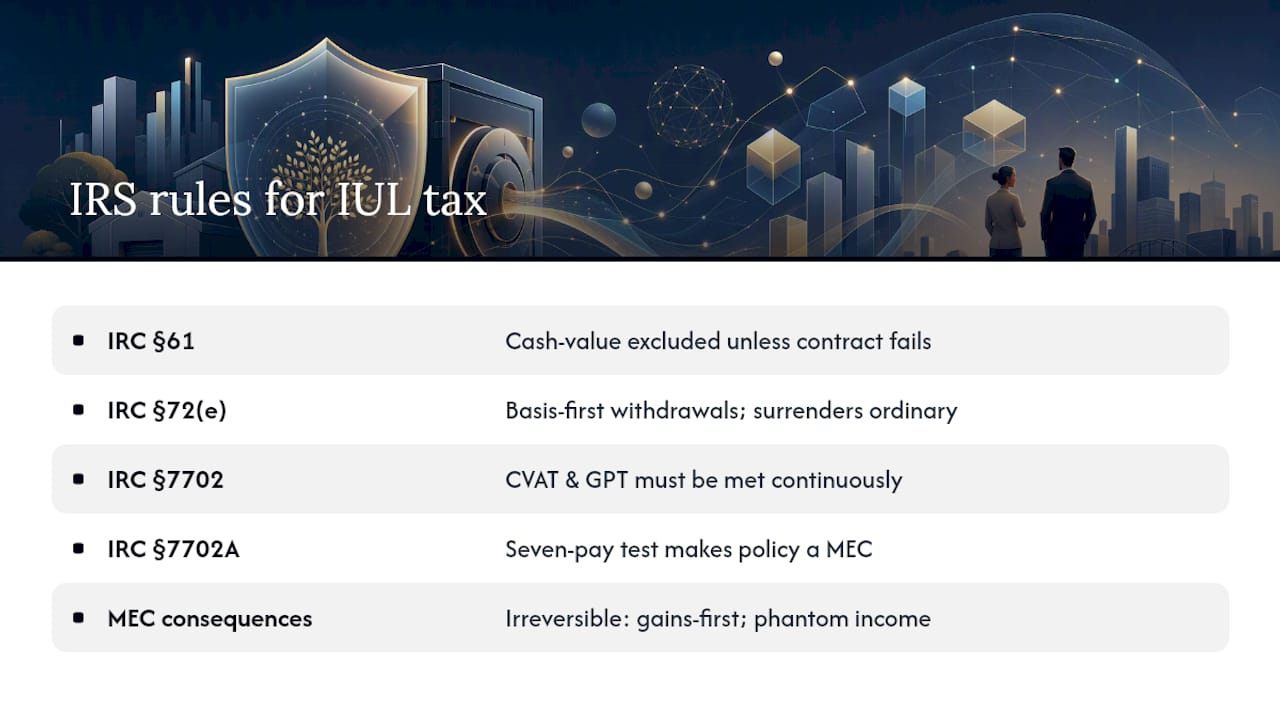
IRC §7702 sets the qualification tests every life insurance contract must pass continuously. The Cash Value Accumulation Test (CVAT) and Guideline Premium Test (GPT) define how much cash value a given death benefit can support. IRS written guidance on §§7702 and 7702A confirms that a contract must continue to satisfy these tests, not just pass them at issue.
IRC §7702A imposes the seven-pay test. If cumulative premiums in the first seven years exceed the net level premium for a paid-up policy, the contract becomes a MEC permanently.
MEC classification is irreversible. Once a policy crosses the seven-pay threshold, every withdrawal and loan is taxed as income-first (gains out first, not basis-first) and subject to a 10% penalty before age 59½. A lapse while loans are outstanding creates “phantom income” — a taxable gain with no cash to pay the tax. LegalClarity’s analysis of IUL tax treatment describes this scenario as one of the most damaging outcomes in personal financial planning.
The practical filing consequence: gains on surrender or lapse are reported as ordinary income on Form 1040. Policy loans, by contrast, produce no 1099 while the policy is in force, which is the core tax advantage of the loan stream.
When does an IUL actually make sense for your retirement plan?
RatesChaser’s practitioner guide is direct: IUL is appropriate primarily for high earners who have already filled their 401(k) and IRA buckets and can commit to overfunding for 15 or more years. For everyone else, term life plus index fund investing is usually the lower-cost path.
Good-fit profile:
- You have maxed your 401(k), Roth IRA, and any available SEP or Solo 401(k) contributions for the year.
- Your income is high enough that additional tax-deferred or tax-free accumulation has real value.
- Cash flow is predictable enough to sustain a consistent premium schedule without gaps.
- You have a 15-plus-year runway before you need income from the policy.
- Estate planning is a concern, making the death benefit component genuinely useful.
Poor-fit profile: you are within 10 years of retirement, still have room in qualified accounts, or your income fluctuates enough that missing premiums is a real possibility. An underfunded IUL with rising COI charges and stagnant cash value is a liability, not an asset.
Progressiveplanner’s Dual Purpose Retirement Strategy™ is explicitly designed as a supplemental bucket, not a replacement for qualified plans. The modeling starts only after confirming qualified accounts are at or near their contribution limits.
What are the real risks and failure modes of IUL strategies?
Most IUL strategies that fail do so for predictable, avoidable reasons.
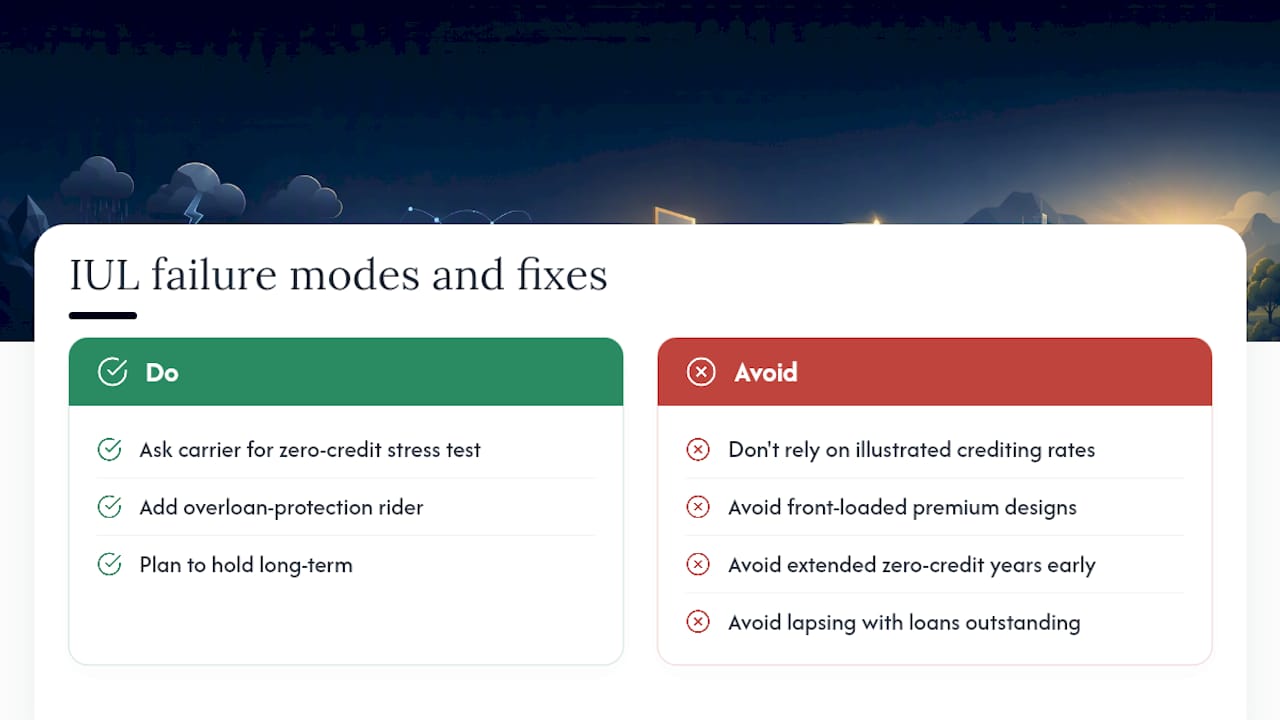
Front-loaded expenses consume a disproportionate share of early premiums. COI, administrative fees, and surrender charges mean cash value builds slowly in years one through five, which is why short holding periods almost always produce negative returns.
Extended zero-credit years compound the damage. A 0% floor protects against index losses, but it does not cover internal charges. Several consecutive flat years early in the policy can set back the accumulation timeline by years.
Rising COI late in life is the structural tension in any universal life product. As you age, the cost of maintaining the death benefit increases, pulling more from cash value. In a loan-heavy retirement phase, this creates a shrinking margin between cash value and outstanding loans.
Policy lapse with loans outstanding is the worst outcome. LegalClarity’s risk analysis notes that an overloan protection rider can convert the policy to reduced paid-up status before lapse, averting a catastrophic tax event. Without that rider, a lapse generates a 1099 for the full gain above basis, including the loan balance that was never taxed.
NerdWallet’s reporting on IUL illustrations and Investopedia’s pros-and-cons analysis both flag that illustrated crediting rates often rely on back-tested historical index performance that overstates realistic lifetime returns.
Pro Tip: Before relying on any IUL illustration for retirement income planning, ask the carrier to run a guaranteed-minimum stress test showing zero crediting every year. If the policy lapses under that scenario before your planned income end date, the design needs to change.
How do you structure an IUL to support the Dual Purpose Retirement Strategy™?
Implementation follows a specific sequence. Skipping steps creates compliance risk or cash-value drag.
- Minimize the death benefit for the premium. Accumulation-focused designs set the death benefit at the lowest level §7702 permits for the planned premium. More premium goes to cash value; less goes to COI.
- Calculate the seven-pay limit before funding. Your advisor runs the §7702A calculation annually. Premium in any policy year must stay below that threshold. A single overfunding event triggers permanent MEC status.
- Set a written premium schedule. Consistent overfunding within the seven-pay limit is the engine of the strategy. Gaps slow accumulation; excess triggers MEC.
- Choose ownership structure deliberately. Individual ownership is standard for personal retirement income. If estate tax exposure is a concern, an Irrevocable Life Insurance Trust (ILIT) keeps the death benefit outside the taxable estate.
- Add an overloan protection rider. This rider converts the policy to paid-up status if loans approach a dangerous threshold, preventing lapse and the phantom-income tax event.
- Schedule annual reviews. Each year, confirm the policy still passes §7702 tests, review the guaranteed-minimum illustration, and ask the carrier for the current COI trend. If the credited rate assumption has changed materially, rerun the retirement income projection.
For policies already in force under a different design, a 1035 exchange can move cash value to a better-structured contract without a tax event, provided the exchange is executed correctly and the new contract is not a MEC.
What does the Dual Purpose Strategy look like with real numbers?
The table below is illustrative, not personal advice. Run personalized modeling with a fiduciary before making any funding decisions.
The gap between scenarios is driven almost entirely by credited rate and COI drag. Under the conservative scenario, the loan stream is meaningful but modest. Under the optimistic scenario, it is substantial. Both scenarios assume the policy never becomes a MEC and never lapses. A guaranteed-minimum (0% credit every year) stress test would show a much narrower or negative loan stream, which is why that test is non-negotiable before committing to a premium schedule.
What should you ask an advisor before signing anything?
Protect yourself with specific questions. A qualified advisor answers all of them without hesitation.
- Ask for the year-by-year net cash-value ledger, not just summary projections. You need to see how cash value behaves in years one through ten, when charges are highest.
- Ask for the guaranteed-minimum stress test showing zero crediting every year through your planned income end date.
- Ask for the §7702A seven-pay calculation in writing, with the annual premium limit stated clearly.
- Ask how the carrier has adjusted cap rates over the past five years. Cap reductions directly reduce future credited rates.
- Ask whether an overloan protection rider is available and what triggers it.
Red flags that indicate a poorly designed policy or misaligned advice:
- The illustration shows only one crediting scenario, and it is the historical average or better.
- The advisor cannot or will not show the guaranteed-minimum scenario.
- The death benefit is sized for maximum coverage rather than minimum COI.
- There is no written plan for what happens if you miss a premium payment.
- The advisor pushes to fund the policy at or near the seven-pay limit in year one without explaining the MEC risk.
Seek a fiduciary second opinion for any design where annual premiums exceed $25,000. The stakes are high enough that an independent review pays for itself.
The conventional wisdom on IUL gets one thing consistently wrong
Most articles about IUL for business owners spend the bulk of their words on the upside: tax-free income, index participation, downside protection. The risks get a paragraph. That ratio is backwards.
The tax advantages of an IUL are real, but they are conditional in a way that most illustrations obscure. The strategy works when the policy is designed for accumulation from day one, funded consistently within §7702A limits, held for 15-plus years, and monitored annually. Remove any one of those conditions and the tax advantages either shrink or disappear entirely. A lapse with loans outstanding does not just end the strategy; it creates a tax bill that can exceed years of premium payments.
What the conventional advice also underweights: the order-of-operations rule is not a suggestion. An IUL purchased before maxing a 401(k) or Roth IRA is almost always the wrong sequence. The tax efficiency of qualified accounts is simpler, cheaper, and more certain. IUL earns its place only in the supplemental tier, after those accounts are full.
The Dual Purpose Retirement Strategy™ gets this right by design. The modeling starts with qualified account maximization, then layers the IUL as a second vehicle. That sequencing is what separates a well-structured plan from an expensive insurance product dressed up as a retirement strategy.
What Progressiveplanner’s Dual Purpose Retirement Strategy™ actually delivers
Two income streams from one premium dollar is a precise engineering problem, not a sales pitch. Progressiveplanner builds the modeling first: a year-by-year projection showing basis withdrawals, projected loan capacity, MEC risk thresholds, and guaranteed-minimum stress-test results, all before a policy is placed.

Every review includes a §7702A compliance check, a written premium schedule, an overloan protection rider recommendation, and an annual monitoring plan. The goal is a policy that performs under conservative assumptions, not just optimistic ones. If the numbers do not work under a conservative crediting scenario, Progressiveplanner says so before you sign anything.
Request your free retirement income review at Progressiveplanner and see exactly what two tax-advantaged income streams could look like for your specific situation.
This article provides general information about IUL policies and U.S. tax rules. It is not personal financial, tax, or legal advice. Consult a licensed financial advisor and tax professional before making any insurance or retirement planning decisions.
Sources
The sources below back the legal and structural claims in this article. For the tax rules, start with the IRS primary sources. For practical design and risk guidance, the practitioner pieces fill in what the statutes leave implicit.
- Revenue Ruling 2009-13 (IRS)
- 26 U.S. Code § 7702 — Definitions and tests for life insurance contracts (Cornell LII)
- IUL Tax-Free Retirement Plan: Benefits and Real Risks - LegalClarity
- Indexed Universal Life (IUL) Insurance Explained – Forbes Advisor
- Pros and cons of IUL — Investopedia
- Indexed Universal Life (IUL) — How it works and whether it’s worth it - RatesChaser
This article is general information, not a substitute for advice from a qualified financial advisor. Consult a qualified financial professional about your own circumstances before acting on anything here.