
RMD Strategies for Retirees Using IUL Insurance

The most effective approach to required minimum distributions combines partial Roth conversions before your first RMD year, account-location optimization, Qualified Charitable Distributions where you’re charitably inclined, and an Indexed Universal Life policy as a tax-advantaged secondary income stream. That combination lowers your future taxable RMD base, protects your Social Security taxation and Medicare IRMAA positioning, and adds non-RMD liquidity through IUL loans and withdrawals. Start planning before RMDs begin — the window before age 73 is where most of the optionality lives.
Three actions to discuss with your advisor now:
- Inventory every pretax account balance and run a Roth conversion projection through your first RMD year
- Model at least three scenarios: base case, aggressive conversion, and conservative conversion
- Schedule a consultation to evaluate whether an IUL policy fits your premium budget and income timeline
Table of Contents
- What are the RMD rules you must understand first?
- Which RMD strategies actually reduce your tax bill?
- How does an IUL policy work alongside your RMD plan?
- How do you implement a Dual Purpose RMD plan step by step?
- What compliance mistakes cost retirees the most?
- What numbers do you need to model before your first RMD?
- Key Takeaways
- Why the conventional wisdom on RMD planning misses the point
- How Progressiveplanner builds your personalized RMD plan
- Useful sources for RMD planning
What are the RMD rules you must understand first?
Required minimum distributions begin at age 73 for traditional IRAs, SEP IRAs, SIMPLE IRAs, and most employer plans. Your first RMD can be delayed to April 1 of the following year, but doing so means two RMDs land in the same tax year, which often pushes you into a higher bracket. Every subsequent RMD is due by December 31.
The calculation is straightforward: divide your prior December 31 account balance by the IRS life-expectancy factor from the Uniform Lifetime Table (or the Joint Life Table if your spouse is the sole beneficiary and more than 10 years younger). The IRS publishes these factors in Publication 590-B.
Aggregation rules trip people up constantly. Multiple traditional IRAs aggregate — you calculate each separately but can satisfy the combined total from any one IRA. Each 401(k) plan, however, requires its own separate distribution. Inherited accounts follow different rules entirely, including the SECURE Act’s 10-year rule for most non-spouse beneficiaries, which requires full distribution by December 31 of the tenth year after the original owner’s death.
Pro Tip: Beneficiary designations directly affect which distribution table applies and how long a beneficiary has to draw down an inherited account. Review them annually, not just at account opening.
Miss an RMD and the penalty is 25% of the shortfall. Correct it within the two-year window and that drops to 10%, filed via Form 5329.
Which RMD strategies actually reduce your tax bill?
The highest-leverage move is a multi-year Roth conversion ladder executed before RMDs start. Converting pretax dollars in years when your income is lower than it will be once Social Security, RMDs, and other income stack up reduces the future taxable balance that drives RMD calculations. The cash-flow cost is real — you pay tax on the converted amount in the conversion year — but the tradeoff often favors conversion when your current marginal rate is lower than your projected RMD-year rate.
Account-location sequencing matters just as much. Drawing from taxable brokerage accounts first in pre-RMD years preserves tax-deferred growth longer. Spending down pretax balances selectively — taking slightly more than you need from an IRA in a low-income year — can reduce the balance that feeds future RMD calculations without triggering a large single-year tax hit.
Qualified Charitable Distributions are one of the most underused tools in retirement. If you’re 70½ or older, you can transfer up to $111,000 per person in 2026 directly from an IRA to a qualified charity. That transfer counts toward your RMD and, critically, does not touch your adjusted gross income. Lower AGI means less Social Security subject to tax and reduced exposure to Medicare IRMAA surcharges. Donor-advised funds and private foundations are not eligible — the transfer must go directly to a qualifying public charity.
Large RMDs push provisional income higher, which can increase the taxable portion of Social Security benefits and trigger IRMAA surcharges on Medicare Part B and Part D premiums two years later. That downstream effect is often larger than the income tax on the RMD itself, which is why coordinating RMD timing with Social Security start dates is frequently the single biggest value driver in a retirement income plan.
Spreading conversions across several years versus concentrating them in one year: systematic partial conversions let you fill a tax bracket each year without crossing into the next tier or an IRMAA threshold. Concentrating conversions in one year can make sense when income is unusually low — a gap year between retirement and Social Security, for example — but the IRMAA look-back means a large conversion year shows up in Medicare premiums two years later.
How does an IUL policy work alongside your RMD plan?
An Indexed Universal Life policy accumulates cash value on a tax-deferred basis, with crediting linked to a market index (commonly the S&P 500) subject to a cap and a floor, typically 0%, that protects against index losses. That downside protection is the structural difference from a variable product.
The income mechanism is the key: properly structured policy loans against cash value can produce tax-advantaged income that does not count as an RMD and does not appear in your AGI. That means IUL loan income doesn’t increase the provisional income that taxes Social Security or trigger IRMAA surcharges. Withdrawals up to your cost basis are also generally tax-free; amounts above basis are taxable.

| Dimension | RMD from Pretax Account | IUL Policy Loan/Withdrawal |
|---|---|---|
| Tax impact | Ordinary income | Generally tax-advantaged up to basis; loans often tax-free |
| Liquidity | Annual mandatory minimum | Flexible; access to cash value |
| Downside protection | Market-exposed account balance | 0% floor on index crediting |
| Fees | Custodian/fund expenses | Premiums, surrender charges, cost of insurance, admin fees |
| Complexity | Moderate | High; requires ongoing policy management |
| Social Security/IRMAA effect | Increases provisional income | Loans generally do not increase AGI |
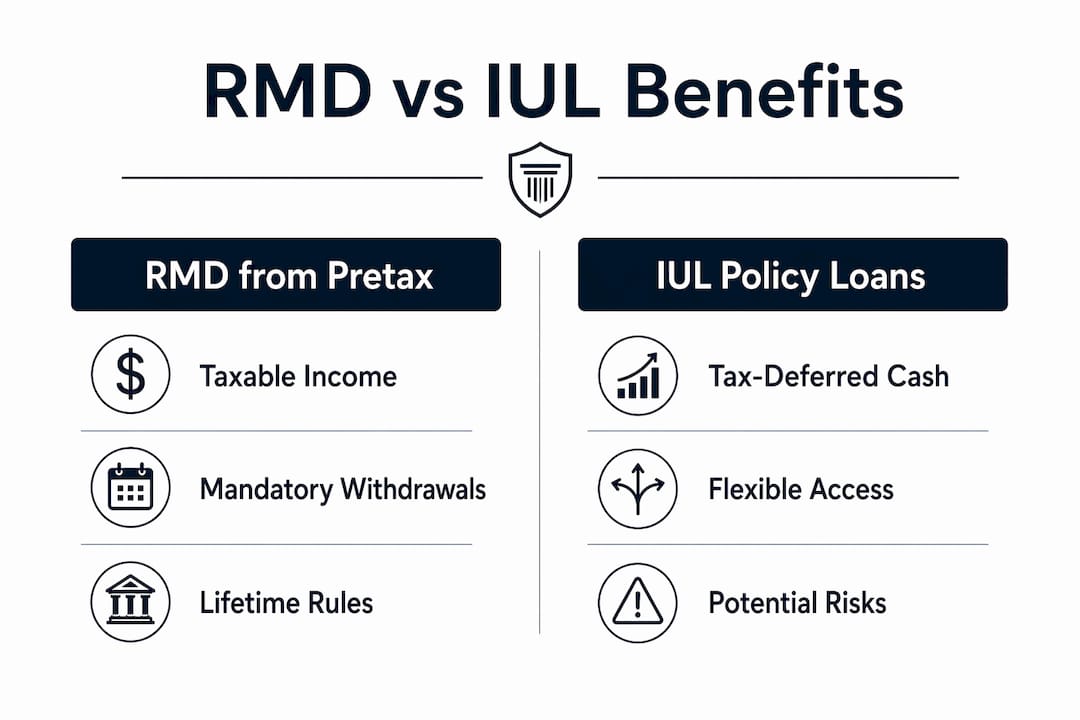
Policy loans carry risk if not managed carefully. An over-loaned policy can lapse, which converts the outstanding loan balance into taxable income — a significant event if the loan has grown large. Surrender charges in early policy years (often 10–15 years) reduce liquidity if you need to exit the policy. Cost of insurance charges increase with age and reduce the net crediting rate. These are real costs that belong in any honest model.
Pro Tip: Ask any IUL illustrator to show you a stress-tested scenario at a lower crediting rate than the illustrated rate — typically 2–3 percentage points lower. That gap is where policies fail.
How do you implement a Dual Purpose RMD plan step by step?
- Inventory accounts and beneficiaries. List every pretax, Roth, and taxable account with its current balance, custodian, and named beneficiary. Note any inherited accounts and their applicable distribution rules.
- Project balances to your first RMD year. Use assumed growth rates to estimate December 31 balances and calculate projected RMDs using the IRS Uniform Lifetime Table factors.
- Decide on Roth conversion amounts. Determine how much to convert each year to fill your current bracket without crossing into the next tier or an IRMAA threshold. Run at least three scenarios.
- Set your QCD plan. If you’re charitably inclined and 70½ or older, establish the annual QCD amount and identify recipient charities. Confirm custodian transfer procedures.
- Design IUL funding cadence. Work with a licensed advisor to determine premium level, policy structure, and projected crediting assumptions. Model the loan capacity against your income needs.
- Set custodian automatic distributions. Submit distribution instructions by mid-November. Year-end processing backlogs at custodians mean late-December requests risk executing in the following tax year, creating a missed-RMD liability.
- Annual maintenance. Re-run the model each year, monitor IRMAA and MAGI windows, confirm custodian RMD automation executed, and review IUL loan and withdrawal drawdown rules with your policy advisor.
Pro Tip: Fund Roth conversions early in the calendar year so the converted amount has the full year to grow tax-free inside the Roth account.
What compliance mistakes cost retirees the most?
The most common and expensive error is missing a deadline because the account owner assumed the custodian handled it. Custodians calculate RMD amounts and may offer automatic distributions, but the account owner is ultimately responsible for taking the correct amount on time. Submit distribution instructions by mid-November, not late December.
Aggregation errors are the second most frequent penalty trigger. IRAs aggregate; 401(k) plans do not. If you have two 401(k) accounts from different employers, each requires its own separate RMD. Conflating these rules is a direct path to a 25% excise tax.
Roth account rules changed under SECURE 2.0. Roth IRAs have no lifetime RMD requirement for the original owner. Roth 401(k) accounts now follow the same rule — no lifetime RMDs for the original owner — but beneficiaries of both are still subject to distribution requirements.
IUL-specific risks to monitor: funding strain if premiums become unaffordable, policy lapse from excessive loans, and surrender charges in early years that reduce net returns if you exit the policy before the surrender period ends.
If you miss an RMD: take a makeup distribution immediately, file Form 5329 with your federal return for the year of the shortfall, and attach a letter of explanation requesting penalty waiver. Correct within two years and the penalty drops from 25% to 10%.
Pro Tip: Test your custodian’s automatic RMD program with a small distribution early in the year to confirm execution timing before relying on it for the full annual amount.
What numbers do you need to model before your first RMD?
A productive advisor conversation requires specific inputs and outputs, not general estimates.
| Model Input | What to Gather |
|---|---|
| Prior-year Dec. 31 balances | Each account separately, including inherited accounts |
| Projected growth rates | By account type (pretax, Roth, taxable, IUL) |
| Social Security start date | Affects provisional income calculation |
| IRMAA thresholds | 2026 MAGI brackets for Medicare Part B/D surcharges |
| QCD capacity | Up to $111,000 per person for qualified charitable distributions in 2026 |
| IUL premium budget | Annual premium and projected crediting rate range |
- Calculate projected RMDs by year using the IRS Uniform Lifetime Table and your projected balances.
- Map marginal tax-rate exposure by year across all income sources.
- Identify IRMAA risk years — years where a Roth conversion or large RMD could push MAGI into the next surcharge tier.
- Project IUL cash value and loan capacity under base-case and stress-tested crediting assumptions.
- Run a breakeven comparison: the tax cost of converting now versus the projected tax on future RMDs if you do not convert.
Lock balances by mid-November each year. Run at least three scenarios — base case, aggressive conversion, and conservative conversion — and test sensitivity to both market returns and IUL crediting assumptions.
Key Takeaways
A tax-first RMD plan combining partial Roth conversions, QCDs, account-location optimization, and an IUL policy as a secondary income stream produces the most flexible and tax-efficient retirement outcome available to most retirees.
| Point | Details |
|---|---|
| Start before age 73 | The pre-RMD window is where Roth conversions and IUL funding have the most impact. |
| QCDs reduce AGI directly | Qualified Charitable Distributions can satisfy RMDs without touching adjusted gross income. |
| Missed RMD penalty | The default excise tax is 25%; correcting within two years reduces it to 10% via Form 5329. |
| IUL loans and AGI | Policy loans generally do not increase provisional income, protecting Social Security and IRMAA positioning. |
| Progressiveplanner | The Dual Purpose Retirement Strategy™ coordinates IUL funding with Roth conversion and RMD timing for two tax-advantaged income streams. |
Why the conventional wisdom on RMD planning misses the point
Most retirement guides treat RMDs as a compliance problem. Take the minimum, pay the tax, move on. That framing is expensive. The real question isn’t how to satisfy the IRS requirement — it’s how to reshape the taxable income picture across a 20-to-30-year retirement so that RMDs, Social Security, and Medicare premiums don’t compound against each other.
The IUL component gets dismissed in a lot of mainstream planning conversations because of the fee complexity. That skepticism is fair when the policy is poorly structured or the crediting assumptions are inflated. But a well-designed IUL, stress-tested at conservative crediting rates and funded at a sustainable premium level, solves a problem that Roth conversions alone cannot: it creates a pool of income that doesn’t appear in AGI, which means it doesn’t touch IRMAA thresholds or the Social Security provisional income calculation. For retirees sitting in the IRMAA danger zone, that distinction can be worth more than the policy’s internal costs.
The Dual Purpose Retirement Strategy™ from Progressiveplanner is built around exactly this coordination — not IUL as a standalone product, but IUL as the second income stream that works alongside a Roth conversion ladder and a disciplined RMD plan. The strategy involves insurance products and paid consultations, and it isn’t the right fit for every situation. But for retirees with meaningful pretax balances and a long planning horizon, the multi-stream approach is worth modeling seriously before the first RMD year arrives.
How Progressiveplanner builds your personalized RMD plan

Progressiveplanner’s Dual Purpose Retirement Strategy™ gives you two tax-advantaged income streams from the same savings dollar — a Roth conversion ladder that reduces future RMD exposure, and an IUL policy that generates income outside your AGI. In a consultation, a licensed advisor models your specific account balances, projected RMDs, Roth conversion capacity, and IUL premium design together, then delivers a personalized timeline and execution checklist you can act on. The consultation also includes an RMD automation check so custodian instructions are in place before year-end deadlines. Specific product placement, including IUL policy selection and underwriting, is handled by licensed insurance advisors. To get your personalized retirement income review, visit progressiveplanner.com and schedule a free discovery call.
This article is general educational information, not tax or financial advice. Confirm current IRS rules and your specific situation with a qualified tax professional or licensed financial advisor.
Useful sources for RMD planning
- IRS: Retirement Topics — Required Minimum Distributions — official RMD start age, calculation method, and aggregation rules
- IRS: Retirement Plan and IRA RMD FAQs — penalty mechanics, correction procedures, and inherited account rules
- IRS Publication 590-B: Distributions from IRAs — life expectancy tables and detailed calculation worksheets
- IRS: IRA RMD Worksheet — step-by-step calculation tool for non-inherited traditional IRAs
- AdvisorGuide: RMD Annual Checklist — year-end timing, custodian automation, and aggregation rule reminders
- OnWealth: How to Plan for RMDs Before They Start — pre-RMD conversion strategy and IRMAA coordination
Save these links for your annual RMD review. Rules, thresholds, and QCD limits are indexed and updated each year, so checking primary IRS sources before each distribution year keeps your plan current.