
IUL vs Whole Life: Which Policy Fits Your Goals?

If your priority is a guaranteed death benefit and predictable premiums you never have to think about, whole life is the clearer fit. If you want growth potential tied to a market index, premium flexibility, and a policy that can double as a retirement income engine, an indexed universal life (IUL) policy is worth a serious look.
Quick match by goal:
- Estate planning and legacy guarantees: Whole life’s fixed premiums and guaranteed cash value make it the more dependable foundation.
- Retirement income supplement and tax-efficient accumulation: IUL’s index-linked crediting and flexible funding structure suit this goal better.
- Infinite banking or policy-loan strategies: Either can work, but whole life’s guaranteed growth and stable loan rates give it an edge for disciplined borrowers.
For a step-by-step decision process and guidance on requesting illustrations, jump to the checklist section below.
Table of Contents
- What is the difference between an IUL and a whole life policy?
- How cash value actually grows in each policy
- How do IUL and whole life compare side by side?
- Pros and cons of each policy
- What does a typical premium look like, and what drives the cost?
- How do you choose? A practical checklist and red flags
- What are the tax and legacy benefits of permanent life insurance?
- Common misconceptions about IUL and whole life
- An option to consider: Progressiveplanner’s Dual Purpose Retirement Strategy™
- How do dividends work in whole life, and what do they do to your policy?
- Can you use either policy as collateral for a loan or business financing?
- Key Takeaways
- How we think about advising clients on this decision
- Ready to see what a structured IUL plan looks like for your retirement?
- Useful sources and further reading
What is the difference between an IUL and a whole life policy?
Whole life insurance is permanent coverage with level premiums that never change, a death benefit that is guaranteed from day one, and cash value that grows at a carrier-guaranteed rate. Mutual companies may also pay annual dividends, which can accelerate cash-value growth or offset premiums, though dividends are not guaranteed. Think of it as the policy for someone who wants to set it, forget it, and know exactly what their family receives.
Indexed universal life insurance is also permanent, but it works differently. Cash value is credited based on the performance of an external index (commonly the S&P 500), subject to a participation rate, a cap, and a contractual 0% floor on index credits. Premiums are flexible: you can increase, decrease, or even skip payments as long as the cash value covers the policy’s cost of insurance. A good fit here is someone funding a retirement income strategy who wants upside potential without direct market exposure.
How cash value actually grows in each policy
Understanding the mechanics is what separates a good policy decision from a regrettable one.
-
Premium allocation. In whole life, every premium goes to the insurer, which credits guaranteed growth and pays dividends when declared. In an IUL, premiums first cover the cost of insurance (COI) and policy fees; the remainder is allocated to an indexed account or a fixed account.
-
Crediting mechanics. Whole life grows at a guaranteed rate, historically around 3–4% in many illustrations, plus any dividend declared by the carrier. IUL credits are tied to index performance: in a positive year, you receive a credit up to the cap (often in the 8–12% range, depending on the carrier and current rates); in a negative year, the 0% floor means you receive no credit, but you also lose nothing from the index calculation.
-
Cost of insurance. This is where IUL requires attention. COI charges rise with age, and if cash value erodes from underfunding or a string of low-credit years, those charges can eat into the account faster than most buyers expect. Whole life companies effectively prepay future COI through higher early premiums, which is why whole life premiums look steep upfront but stay level forever.
-
Policy loans and withdrawals. Both policy types allow loans against cash value. Loans are generally income-tax-free while the policy stays in force, but an outstanding loan balance at lapse can trigger ordinary income tax on the forgiven gain. Outstanding loans also reduce the death benefit dollar for dollar if unpaid at death.
A concrete contrast: In a year when the S&P 500 drops 20%, an IUL policyholder receives a 0% index credit. No loss, but no gain either, and COI still comes out of cash value. In that same year, a whole life policyholder receives the guaranteed crediting rate plus whatever dividend the carrier declares. The whole life policy grows; the IUL treads water.
Pro Tip: Always request both the guaranteed and non-guaranteed illustration columns before signing anything. Ask the agent specifically what index crediting rate, participation rate, and cap assumption the non-guaranteed column uses, and request a version run at a lower assumed rate to stress-test the projection.

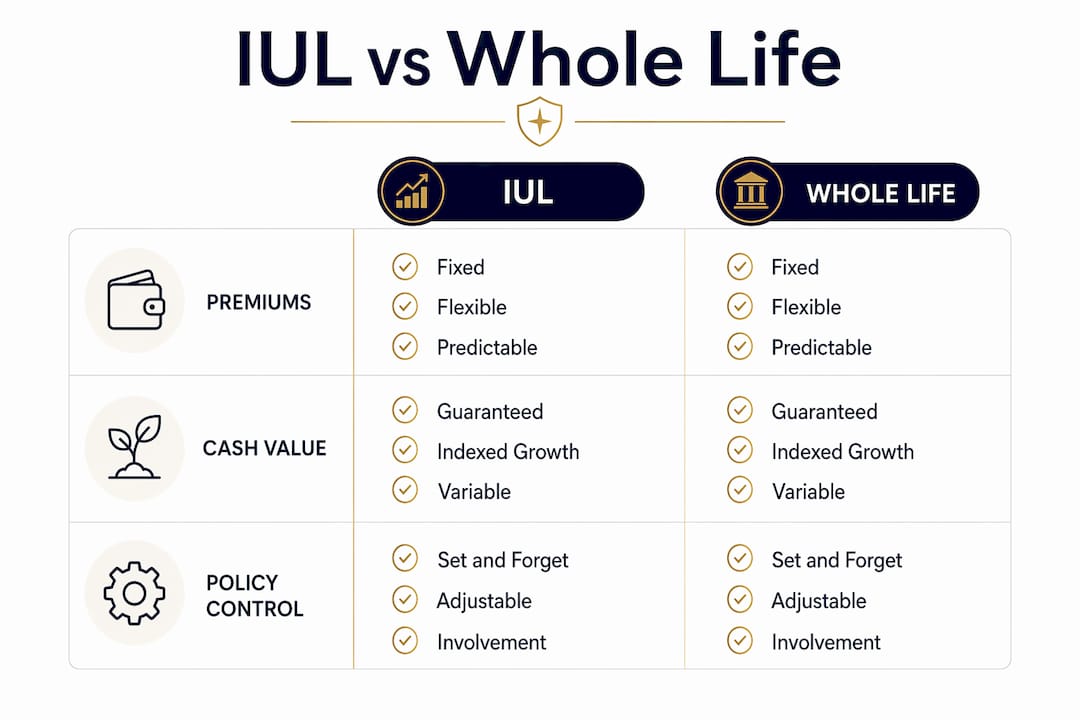
How do IUL and whole life compare side by side?
Three questions help you frame each dimension: How stable must your premiums be? How involved are you willing to be in ongoing policy management? Do you need guaranteed cash-value growth, or is index-linked potential enough?
| Dimension | Whole Life | IUL |
|---|---|---|
| Premium predictability | Fixed for life; never changes | Flexible; can increase, decrease, or skip within limits |
| Cash-value growth | Guaranteed rate plus potential dividends | Index-linked credits with 0% floor; subject to caps and participation rates |
| Guarantees and downside protection | Carrier-guaranteed growth; strong contractual floor | 0% floor on index credits; no guaranteed positive return |
| Death benefit stability | Guaranteed level benefit from issue | Flexible; can vary with funding and outstanding loans |
| Complexity and management | Low; minimal ongoing decisions required | Moderate to high; annual review of COI, credits, and funding level needed |
| Fees and cost structure | Higher fixed premiums; COI pre-loaded | Lower initial outlay possible; COI rises with age |
| Best use case | Estate planning, guaranteed legacy, infinite banking | Retirement income supplement, tax-efficient accumulation, flexible funding |

The choice between these products comes down to your primary financial goal: predictability and a guaranteed legacy, or growth potential and funding flexibility. Policy design quality often matters more than the product label itself.
Pros and cons of each policy
Whole life
Top 5 pros:
- Guaranteed death benefit that never lapses as long as premiums are paid.
- Fixed premiums that make budgeting straightforward for decades.
- Guaranteed cash-value growth, independent of market conditions.
- Dividends from mutual carriers can accelerate cash value or reduce out-of-pocket premiums.
- Simple to manage; no annual monitoring of crediting rates or COI charges required.
Top 5 cons:
- Premiums are significantly higher than term for the same death benefit.
- Growth potential is capped; you will not capture equity-market upside.
- Less flexibility if your income changes and you need to reduce payments.
- Dividends are not guaranteed, despite the historical reliability of some mutual carriers.
- Surrender charges and slow early cash-value accumulation can make early exits costly.
IUL
Top 5 pros:
- Premium flexibility lets you adjust payments as your financial situation changes.
- Index-linked crediting offers higher growth potential than whole life’s guaranteed rate.
- The 0% floor prevents negative index credits in down-market years.
- Can be structured as a tax-advantaged retirement income vehicle when properly funded.
- Death benefit can be adjusted (within limits) to match changing coverage needs.
Top 5 cons:
- No guaranteed positive return; a string of 0% credit years still costs you COI.
- COI charges rise with age and can erode cash value if the policy is underfunded.
- Illustration assumptions (caps, participation rates) can be optimistic and are adjustable by carriers.
- Requires active monitoring; neglect can lead to policy lapse.
- Greater complexity means a higher risk of misunderstanding what you own.
Pro Tip: Both product types offer riders worth asking about, including long-term care (LTC) riders and accelerated death benefit riders. An LTC rider on either policy can cover care costs without a separate policy, which adds real value for buyers in their 40s and 50s who want to address that risk now while premiums are lower.
What does a typical premium look like, and what drives the cost?
Several factors determine what you will pay: your age at issue, health classification, the target death benefit, and how you structure the payment pattern. Whole life locks in a level premium for life, which means the insurer prices in decades of future COI from the start. An IUL can be funded more lightly at first, but that flexibility comes with the risk of underfunding as COI charges climb.
Illustrative example (not a quote; figures are for comparison purposes only): A healthy 45-year-old male seeking substantial permanent coverage might see a whole life illustration costing significantly more per month than an IUL targeting the same benefit, though specific costs vary greatly, with the lower end requiring careful funding discipline to avoid lapse in later years. The gap narrows or reverses if the IUL is overfunded to maximize cash-value accumulation.
The right action is to request multiple carrier illustrations and compare them on a level playing field: same death benefit, same insured age and health class, and both showing guaranteed and non-guaranteed columns side by side. A term-conversion comparison is also worth running if you currently hold term coverage.
How do you choose? A practical checklist and red flags
Step-by-step decision checklist
- Identify your primary goal. Guaranteed legacy and estate transfer point toward whole life. Retirement income accumulation and funding flexibility point toward IUL.
- Confirm your premium budget. If you need a fixed, predictable payment, whole life is the safer structure. If you want the option to vary contributions, IUL fits better.
- Assess your management appetite. IUL requires annual review of crediting rates, COI charges, and cash-value levels. If you will not do that, whole life is the more forgiving choice.
- Request illustrations with uniform assumptions. Ask for both guaranteed and non-guaranteed lines, and request a stress-test version at a lower crediting rate.
- Check carrier financial-strength ratings. Verify A.M. Best and S&P ratings before committing. A financially strong carrier matters more for whole life (where guarantees are only as good as the company behind them) but is critical for both.
Questions to ask your agent
- What index crediting rate does the non-guaranteed illustration assume, and what is the current cap and participation rate?
- How has this carrier’s dividend scale or cap rate changed over the past ten years?
- What is the COI structure, and at what age does it become a material drag on cash value?
- What happens to the policy if I miss two or three premium payments?
- What is the loan interest rate, and is it fixed or variable?
- Can you show me the guaranteed column only, and what does the policy look like at age 80 under that scenario?
Red flags that warrant a pause
- Illustrations that require continuous maximum overfunding to avoid lapse.
- Non-guaranteed projections using cap rates or participation rates at the current maximum with no stress-test scenario.
- An agent who cannot or will not explain the COI structure clearly.
- No discussion of what happens if the carrier reduces the cap rate in future years.
Always verify carrier A.M. Best and S&P financial-strength ratings independently. A strong rating is not a guarantee of future performance, but it is the baseline check that belongs in every permanent-insurance decision.
What are the tax and legacy benefits of permanent life insurance?
Both IUL and whole life share the same core tax advantages, which is one reason they are worth comparing against other retirement vehicles.
- Death benefits are generally received income-tax-free by beneficiaries under IRC Section 101(a).
- Cash-value growth is tax-deferred; you owe no income tax on credited interest or dividends while the policy is in force.
- Policy loans are not taxable income as long as the policy remains in force. Withdrawals up to basis are also tax-free, but amounts above basis are taxable.
- Lapse risk: If a policy lapses with an outstanding loan, the forgiven gain is treated as ordinary income in the year of lapse. This is one of the most overlooked tax traps in permanent insurance.
On the legacy side, life insurance death benefits pass directly to named beneficiaries, bypassing probate entirely. For large estates, the death benefit may be included in the taxable estate if the insured owns the policy. An irrevocable life insurance trust (ILIT) can remove the benefit from the estate, but that requires coordination with an estate attorney. For any estate where the total value approaches federal estate-tax thresholds, treating life insurance as a standalone product without legal counsel is a mistake.
Pro Tip: If your estate is large enough that estate taxes are a real concern, bring an estate attorney into the conversation before you apply for coverage. The ownership structure of the policy matters as much as the policy itself.
Common misconceptions about IUL and whole life
-
“IUL is always riskier than whole life.” Not quite. The 0% floor means you cannot lose index-linked credits in a down year. The real risk in IUL is management neglect and underfunding, not direct market loss. A well-designed, actively monitored IUL carries a different risk profile than a poorly funded one.
-
“Whole life is always a bad deal.” This objection, popularized by commentators like Dave Ramsey, applies most accurately to policies sold without a clear purpose. For estate planning, guaranteed legacy transfer, or infinite-banking strategies, whole life’s guarantees are the feature, not a bug.
-
“Dividends on whole life are guaranteed.” They are not. Dividends are declared annually by mutual companies and can be reduced or eliminated. Some carriers have paid dividends consistently for over a century, but past dividend history is not a contractual promise.
-
“Policy loans are free money.” Loans are tax-advantaged, not free. They accrue interest, reduce the death benefit if unpaid, and can trigger a taxable event if the policy lapses with a loan outstanding. Treating them as a no-cost ATM is one of the fastest ways to undermine a permanent insurance strategy.
An option to consider: Progressiveplanner’s Dual Purpose Retirement Strategy™
Progressiveplanner’s Dual Purpose Retirement Strategy™ addresses a central problem with IUL: the gap between what an illustration shows and what a poorly managed policy actually delivers.
The strategy uses an IUL policy to create two tax-advantaged income streams from the same retirement dollars, rather than sheltering savings in a single bucket like a 401(k) or IRA. The core idea is that the same contribution can serve both a retirement income function and a legacy function simultaneously.
How it mitigates common IUL risks:
- Conservative illustration assumptions: Projections are built with conservative crediting assumptions, not the maximum cap rate the carrier currently offers.
- Active policy management: Annual reviews of COI charges, crediting performance, and funding levels are built into the process, not left to the policyholder to remember.
- Pairing guaranteed components where appropriate: For clients where a guaranteed floor matters, the strategy can incorporate guaranteed elements alongside the IUL structure.
To see how this applies to your situation, request a conservative illustration or schedule a retirement income review. Recommendations depend on individual suitability and underwriting.
This article is general information, not personalized financial or legal advice. Confirm current rules and product suitability with a licensed insurance professional for your specific situation.
How do dividends work in whole life, and what do they do to your policy?
Whole life dividends are a share of the carrier’s surplus, declared annually by the board of a mutual insurance company. They are not guaranteed, but some mutual carriers have paid them consistently for decades.
When a dividend is declared, you typically have four options: take it as cash, apply it to reduce your next premium payment, leave it to accumulate at interest inside the policy, or use it to purchase paid-up additions (PUAs). PUAs are the most powerful option for cash-value growth: each addition is a small, fully paid-up chunk of additional insurance that itself earns future dividends and guaranteed interest. Over time, PUAs can meaningfully accelerate both cash value and the total death benefit beyond what the base policy alone would produce.
The practical implication: two whole life policies with identical base premiums can look very different at year 20 depending on how dividends were applied and whether the carrier’s dividend scale held up. Always ask for the dividend history of the specific carrier, not just the current illustrated rate.
Can you use either policy as collateral for a loan or business financing?
Both whole life and IUL cash values can be used as collateral, but lenders treat them differently, and the distinction matters if you plan to use the policy for business purposes or as part of a financing strategy.
Whole life is generally more acceptable to traditional lenders as collateral. The guaranteed cash value is a known, contractually defined number that a bank can underwrite with confidence. Some lenders will extend a line of credit against whole life cash value at favorable rates precisely because the collateral does not fluctuate.
IUL cash value is less predictable from a lender’s perspective. Because the credited value depends on index performance and is subject to COI charges, the collateral value can vary year to year. Some lenders will accept IUL cash value, but they may apply a larger haircut to the collateral value or require additional documentation.
For business owners using a policy as part of a buy-sell agreement or key-person coverage, whole life’s guaranteed values make the underwriting conversation simpler. IUL can still work in these contexts, but the business owner should confirm the lender’s specific requirements before structuring the policy. If alternative retirement assets are also part of the picture, coordinating how each asset class is treated as collateral is worth a conversation with a financial advisor.
Key Takeaways
Whole life delivers guaranteed growth and a predictable death benefit; IUL offers index-linked upside and premium flexibility, but only performs as designed when actively managed and conservatively illustrated.
| Point | Details |
|---|---|
| Match product to primary goal | Whole life fits guaranteed legacy and estate planning; IUL fits retirement income accumulation and flexible funding. |
| Illustration assumptions drive outcomes | Always compare guaranteed and non-guaranteed columns; request a stress-test at a lower crediting rate before committing. |
| Carrier strength matters | Verify A.M. Best and S&P financial-strength ratings for any carrier you consider; guarantees are only as solid as the company behind them. |
| Policy loans carry real risk | Loans are tax-advantaged, not free; a lapse with an outstanding loan can trigger ordinary income tax on the forgiven gain. |
| Progressiveplanner’s approach | The Dual Purpose Retirement Strategy™ uses a conservatively designed IUL to create two tax-advantaged income streams from the same retirement dollars. |
How we think about advising clients on this decision
The IUL-versus-whole-life debate gets framed as a product competition, but the more useful frame is: what problem are you actually trying to solve? A client who wants to know their family receives exactly $1 million regardless of what markets do needs a different tool than a client who wants to maximize tax-free retirement income from the same premium dollar.
At Progressiveplanner, the process starts with goals, not products. Before any illustration is run, the conversation covers primary objective, premium budget, time horizon, and how involved the client wants to be in ongoing management. Only after that does a product recommendation make sense. IUL is not the right answer for everyone, and we say so.
When IUL is the right fit, the guardrails matter as much as the product. Conservative crediting assumptions, a defined funding threshold, annual policy reviews, and a clear understanding of what happens if the client misses payments are all part of the recommendation. A policy that looks great on a maximum-illustrated projection but collapses under a realistic stress-test is not a recommendation we make.
Ready to see what a structured IUL plan looks like for your retirement?
Most people comparing permanent life insurance never see a conservative illustration. They see the best-case projection, and that is the number that sticks. Progressiveplanner’s retirement income review changes that: you get a side-by-side comparison of guaranteed and non-guaranteed outcomes, a conservative projection built on realistic crediting assumptions, and a funding plan that accounts for your actual budget and timeline.

The review is designed for people who already have a 401(k) or IRA and want to understand whether adding an IUL through the Dual Purpose Retirement Strategy™ could create a second tax-advantaged income stream from the same savings. Recommendations depend on individual underwriting and suitability. To get started, schedule your retirement income review at Progressiveplanner.com.
Useful sources and further reading
- Texas Department of Insurance — Life Insurance Consumer Guide: Plain-language overview of life insurance types, policy provisions, and buyer rights under Texas law; useful for understanding policy terms and consumer protections.
- Maryland Insurance Administration — Life Insurance Overview: State-level consumer guide covering permanent insurance mechanics, illustration standards, and policyholder rights.
- IRS Publication 525 — Taxable and Nontaxable Income: Primary source for the tax treatment of life insurance proceeds, policy loans, and surrender gains.
- A.M. Best: The standard reference for carrier financial-strength ratings; use it to verify any insurer’s rating before purchasing a permanent policy.
- NAIC Life Insurance Buyer’s Guide: The National Association of Insurance Commissioners’ official consumer guide; covers how to read an illustration and compare policies across carriers.