
Sequence of Returns Risk: Protect Your Retirement Income

Sequence-of-returns risk is the danger that poor early retirement returns permanently shrink your portfolio, even when your long-term average looks fine. The single most important action you can take right now: protect the first 5–10 years of withdrawals before you retire.
- QuantCalc’s simulation found that identical $1M portfolios with identical withdrawals produced widely differing median terminal wealth depending on the sequence of returns — a large gap driven entirely by order.
- The years immediately surrounding retirement are a critical period for sequence risk management; your portfolio is typically at its largest and most exposed.
- Kitces research shows a two-year retirement flexibility window can improve median final portfolio value by roughly 40%.
- Tax-aware strategies such as Roth conversions, access to cash value in insurance policies, and maintaining cash buckets can reduce the need to sell pre-tax assets at depressed prices during downturns.
Pro Tip: Pre-fund 12–24 months of living expenses in cash or short-term bonds before your retirement date. This single buffer lets your equity portfolio recover without forcing you to sell at a loss during the first bear market you face.
Table of Contents
- What is sequence-of-returns risk and why do average returns mislead?
- How different early-return sequences change 30-year portfolio outcomes
- When does sequence risk matter most for your retirement timing?
- Practical ways to reduce sequence-of-returns risk
- How an IUL policy can address sequence risk — and what it costs you
- How Progressiveplanner’s Dual Purpose Retirement Strategy™ addresses sequence risk
- Questions to ask an advisor before buying an IUL or annuity
- Your 90-day action plan for sequence risk
- Key Takeaways
- Why tax-aware sequence risk planning matters more than most advisors admit
- Progressiveplanner’s Dual Purpose Retirement Strategy™ for sequence risk
- Authoritative sources and further reading
What is sequence-of-returns risk and why do average returns mislead?
Average annual returns are a poor guide for retirees. A portfolio that earns +20%, then -20%, then +20% has the same arithmetic average as one that earns -20%, +20%, +20% — but if you are withdrawing money throughout, the outcomes are radically different.
Here is the core mechanism:
- Withdrawal timing: When you sell shares to fund living expenses during a down market, you lock in losses permanently.
- Shrinking base: Fewer shares remain to participate in the eventual recovery, so the rebound does less work.
- Compounding loss: Each forced sale at depressed prices accelerates portfolio depletion.
Investopedia defines sequence risk as the danger that the timing of withdrawals from a retirement account will negatively impact the overall rate of return available to the investor. MIT Sloan research confirms that losses in the first several years of distribution are the most detrimental, with one estimate attributing 77% of the final retirement outcome to the average return of the first 10 years.
Conceptual illustration: same average, different order
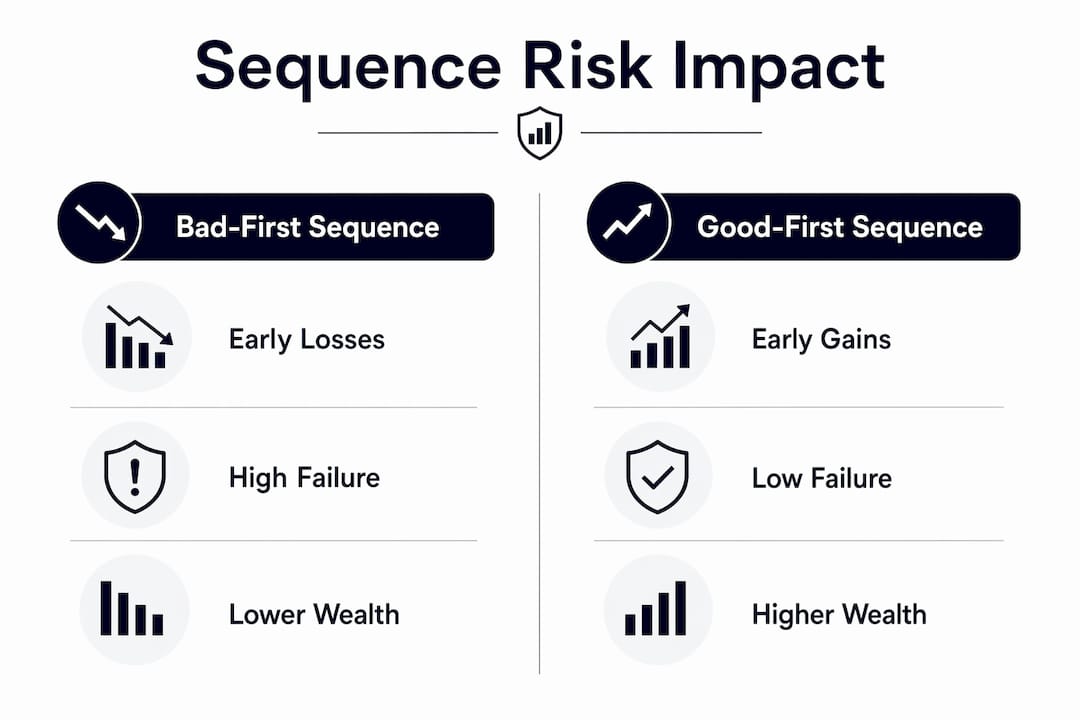
| Sequence | Early Returns | Late Returns | Avg. Annual Return | Outcome |
|---|---|---|---|---|
| Bad-first | Negative | Positive | Moderate | Portfolio depleted early |
| Neutral | Mixed | Mixed | Moderate | Moderate longevity |
| Good-first | Positive | Negative | Moderate | Portfolio survives 30+ years |
The table makes the point plainly: the math of averages hides the timing problem entirely.
How different early-return sequences change 30-year portfolio outcomes
The same average return can produce wildly different results depending on when the bad years hit. QuantCalc modeled this directly.

| Scenario | First-Decade Character | Median Terminal Wealth | Failure Rate |
|---|---|---|---|
| Bad-first decade | 1973–1974 bear market | Lower terminal wealth | Higher failure rate |
| Average sequence | Mixed early returns | Moderate terminal wealth | Moderate failure rate |
| Good-first decade | Positive early returns | Higher terminal wealth | Low failure rate |
Assumptions: $1M starting portfolio, balanced allocation, 4% initial withdrawal rate, start-of-year withdrawals.
That 46% failure rate for a bad-start cohort is not a fringe scenario — it mirrors real historical periods like 1973–1974. The good-first cohort, using the exact same dollars and the exact same average return, never ran out of money. Order alone drove the difference.
Flexible responses matter here too. QuantCalc notes that spending cuts and cash buffers can convert worst-case failure scenarios into survivable outcomes, which is why rigid, unchanging withdrawal plans amplify the damage.
When does sequence risk matter most for your retirement timing?
The five-year window on either side of your retirement date is when sequence risk is at its sharpest. Your portfolio is at peak size, so a 20% decline costs far more in absolute dollars than the same percentage drop a decade earlier when the balance was smaller.
Timing tactics worth running before you lock in a date:
- Stress-test early returns: Run projections through a bear market in years one through five and a prolonged inflation period in early retirement.
- Model retirement-date flexibility: Kitces analysis shows that a two-year window around your planned date can improve median outcomes by roughly 40% by changing your cohort exposure, not just your return sequence.
- Pre-fund living expenses: Hold 1–3 years of spending in cash or short-term bonds before you retire.
- Evaluate tax drag: Withdrawing from pre-tax 401(k) or IRA accounts during a downturn compounds sequence risk with tax drag simultaneously.
Pro Tip: Ask your advisor to model two scenarios: retiring at your target date versus retiring two years later if markets decline 20% in year one. The difference in projected 30-year income often justifies the flexibility.
Practical ways to reduce sequence-of-returns risk
The highest-impact levers are a cash buffer, dynamic withdrawals, and guaranteed income. No single tool handles every dimension, so the comparison below covers the key tradeoffs.
| Strategy | Liquidity | Downside Protection | Tax Treatment | Costs/Fees | Complexity | Income Reliability |
|---|---|---|---|---|---|---|
| Cash bucket | High | Moderate | Taxable interest | Low | Low | No guarantee |
| Dynamic withdrawals | High | Moderate | Depends on account | Low | Moderate | No guarantee |
| Fixed annuity | Low | High | Tax-deferred growth | Moderate | Moderate | Guaranteed |
| IUL cash value | Moderate | High (floor) | Tax-advantaged loans | Higher | High | Depends on policy |
When each approach fits best:
- Cash bucket: Best as a first line of defense; 1–3 years of expenses in cash or short-term bonds prevents forced equity sales during early downturns.
- Dynamic withdrawals: Guardrail-based spending rules (reduce withdrawals when the portfolio drops below a threshold) work well for disciplined retirees who can tolerate spending variability.
- Fixed annuity: Converts a portion of savings into guaranteed income, removing sequence risk from that slice entirely. The tradeoff is illiquidity and inflation exposure.
- IUL cash value: Provides tax-advantaged income and downside protection, but carries higher fees and complexity that require careful advisor review.
Inflation interacts with all of these. A fixed annuity that looks adequate today may fall short in a prolonged high-inflation period. Dynamic withdrawal plans need an inflation adjustment built in. Cash buckets erode in real value if held too long.
How an IUL policy can address sequence risk — and what it costs you
An Indexed Universal Life policy credits interest based on the performance of a market index (commonly the S&P 500), subject to a cap and a floor. The floor, typically 0%, means your cash value does not decline in a down market year. That single feature is what makes IUL relevant to sequence risk.
Key IUL features for sequence-risk protection:
- Downside floor: Cash value does not go negative in a bad market year, so you are not forced to sell at a loss.
- Tax-deferred growth: Cash value accumulates without annual income tax, similar to a 401(k) but with different rules.
- Policy loans: You can access cash value via loans that are generally income-tax-free, providing a withdrawal source that does not trigger a taxable event during a downturn.
- Death benefit: Provides a legacy component, though this adds to the cost of the policy.
The tradeoffs are real and worth stating plainly. Caps on index crediting (often 8%–12% annually) limit upside. Participation rates below 100% mean you capture only a fraction of index gains. Internal fees — cost of insurance, administrative charges, and surrender charges in early years — can meaningfully reduce net returns if the policy is underfunded or surrendered early. Liquidity is constrained in the first several years due to surrender charges.
Before purchasing, request: the illustrated crediting rate versus the guaranteed minimum, the full fee schedule, the surrender charge schedule, and a stress-tested illustration at a lower crediting rate (ask for 4%–5% rather than the illustrated maximum).
Pro Tip: Model an IUL alongside your existing 401(k) or IRA to identify which account you draw from first in a down market. Using IUL loans in bad years and letting pre-tax accounts recover can reduce both sequence risk and your lifetime tax bill.
How Progressiveplanner’s Dual Purpose Retirement Strategy™ addresses sequence risk
Progressiveplanner’s Dual Purpose Retirement Strategy™ is built around one core idea: the same savings dollar can fund two tax-advantaged income streams instead of one, which directly reduces sequence risk exposure in early retirement.
The strategy components:
- Short-term liquidity preservation: Protect the first years of retirement with a cash or near-cash buffer so equity accounts are not touched during downturns.
- IUL cash value for tax-advantaged income: Use policy loans from an IUL to fund living expenses in down-market years, leaving pre-tax accounts untouched to recover.
- Roth conversion coordination: Convert pre-tax balances to Roth during lower-income years to reduce future forced withdrawals.
- Staged withdrawal sequencing: Draw from accounts in a tax-efficient order — coordinating 401(k)/IRA, IUL, and taxable accounts to minimize tax drag across a 20–30 year retirement.
Some clients report significant increases in projected retirement income compared to traditional single-bucket approaches. These are client-reported, proprietary outcomes and will vary based on individual circumstances, policy design, and market conditions.
A note on due diligence: always ask about commissions, fees, and the assumptions behind any policy illustration before committing. A well-structured IUL inside this strategy should be stress-tested at conservative crediting rates, not just the illustrated maximum.
Questions to ask an advisor before buying an IUL or annuity
The single most important question: does this product protect my first 5–10 years of withdrawals without creating other outsized costs?
Questions to bring to every advisor conversation:
- What crediting rate is this illustration based on, and what does it look like at 4%?
- What are the total internal policy fees in years 1, 5, and 10?
- What is the surrender charge schedule, and when does it expire?
- How do policy loans affect the death benefit and cash value if markets underperform?
- How does this product coordinate with my Roth conversions and 401(k) drawdown?
- What guaranteed income alternatives (fixed annuities) have you compared this against?
Due-diligence checklist:
- Collect your most recent 401(k), IRA, and taxable account statements.
- Request a policy illustration at both the illustrated and a conservative (4%–5%) crediting rate.
- Ask for the full surrender charge schedule in writing.
- Run a stress-test scenario: what happens if markets drop 30% in year two of retirement?
- Consult a fee-only financial advisor or CPA to review the tax implications independently.
- Verify the advisor holds the appropriate insurance and securities licenses for your state.
Your 90-day action plan for sequence risk
The single most important next step: run stress tests for first-decade returns and build a 12–36 month liquidity buffer before you retire.
Days 0–30:
- Collect all account statements (401(k), IRA, taxable, existing insurance).
- Run a sequence-risk scenario using a free tool or ask your advisor to model a 1973-style first decade.
- Identify how many months of expenses you currently hold in cash or short-term bonds.
Days 30–60:
- Consult a licensed financial advisor about bucket strategy implementation.
- Request IUL policy illustrations from at least two carriers; compare at conservative crediting rates.
- Evaluate whether a Roth conversion makes sense in the current tax year.
Days 60–90:
- Fund your cash bucket to cover 12–24 months of essential expenses.
- Make a retirement-date decision based on stress-test results, not just a calendar target.
- If markets decline during this window: pause Roth conversions, draw from the cash bucket rather than selling equities, and revisit your withdrawal rate.
For additional context on retirement portfolio diversification and how non-traditional assets fit into a sequence-risk-aware plan, that resource covers the role of alternative holdings alongside traditional allocations.
Key Takeaways
Sequence-of-returns risk, not average returns, is the primary driver of whether a retirement portfolio survives — and the first decade of withdrawals determines most of the outcome.
| Point | Details |
|---|---|
| Order drives outcomes | QuantCalc’s simulation found that identical $1M portfolios and identical withdrawals produced a roughly 6× difference in median terminal wealth depending on the sequence of returns—$318k for a bad-start cohort versus $1.96M for a good-start cohort—all with the same average return. |
| Critical 5-year window | The five years before and after retirement are when sequence risk is sharpest; your portfolio is at peak size and most exposed. |
| Two-year flexibility | Kitces research shows that a two-year retirement-date window can improve median final portfolio value by roughly 40%. |
| Primary mitigations | Cash buckets, dynamic withdrawals, fixed annuities, and IUL each address sequence risk with different liquidity and cost tradeoffs. |
| Progressiveplanner’s approach | The Dual Purpose Retirement Strategy™ uses IUL cash value and staged withdrawal sequencing to create two tax-advantaged income streams and reduce forced pre-tax withdrawals in down markets. |
Why tax-aware sequence risk planning matters more than most advisors admit
Most retirement conversations focus on accumulation — how much you saved, what your average return was, whether you hit your number. The sequence-of-returns problem exposes a flaw in that framing. You can do everything right for 30 years and still run out of money if the first bear market hits in year two of retirement.
What gets underestimated is the tax dimension. Pulling from a 401(k) during a market downturn does not just lock in investment losses — it also triggers ordinary income tax on the withdrawal, often at a higher effective rate than you would pay in a stable year. That double hit (investment loss plus tax drag) is what makes pre-tax-only retirement strategies fragile. Having a tax-free source of income — whether a Roth account, an IUL policy loan, or a combination — gives you genuine flexibility to let pre-tax accounts recover without paying the IRS for the privilege of surviving a bear market.
The goal is not to predict markets. It is to build a structure that does not force you to make the worst financial decision (selling low, paying taxes on losses) at the worst possible time.
Progressiveplanner’s Dual Purpose Retirement Strategy™ for sequence risk
Two tax-advantaged income streams from the same savings dollar is the concrete advantage Progressiveplanner offers over a traditional single-account approach — and that structure directly addresses the sequence-risk problem described throughout this article.

Where a 401(k)-only retiree is forced to sell equities in a down market, a client using the Dual Purpose Retirement Strategy™ can draw from IUL cash value via tax-free policy loans, leaving the 401(k) untouched to recover. Some clients report significant projected income increases compared to traditional methods. Services include:
- Personalized retirement income reviews comparing single-bucket versus dual-stream projections
- IUL policy illustrations stress-tested at conservative crediting rates
- Roth conversion coordination and staged withdrawal sequencing across account types
Ready to see what your retirement income looks like with sequence risk built into the model? Request a retirement income review with Progressiveplanner and get a personalized projection that accounts for the first-decade risk your current plan may be ignoring.
This article is general information, not professional financial, tax, or legal advice. Consult a licensed advisor and the IRS or CFP Board for guidance specific to your situation.
Authoritative sources and further reading
These sources ground the modeling, timing research, and tax guidance referenced throughout this article. For rules-specific questions, consult the IRS directly or a licensed CPA.
- QuantCalc — Sequence of Returns Risk Research: The 50,000-path simulation showing the 6× terminal wealth gap and 46% failure rate for bad-start cohorts.
- Kitces — Retirement Date Flexibility and Sequence Risk: Quantifies the ~40% median improvement from a two-year retirement window; explains cohort versus ordering risk.
- InvestmentNews — Timing and Sequence Risk: Advisor perspectives on stress-testing, cash buckets, Roth conversions, and tax-aware drawdown sequencing.
- Investopedia — Sequence Risk Definition: Standard definitional reference and overview of common mitigation strategies.
- MIT Sloan — Mitigating SORR: Academic framing of how early-retirement losses drive final outcomes; the 77% attribution finding.
- Accelerated Life Solutions — Retirement Review Case Study: A real-world example of how a retirement review can surface significant hidden policy value in life-insurance-based strategies.