
IUL vs Annuity: Which Fits Your Retirement Goals?

If your top priority is guaranteed income you cannot outlive, an annuity is the stronger choice. If you need permanent life insurance with tax-advantaged cash value you can access flexibly, an Indexed Universal Life policy is the better fit. The clearest rule of thumb: use an annuity to cover essential retirement expenses, use an IUL when you also need a death benefit and flexible liquidity, and consider running both together under a structure like Progressiveplanner’s Dual Purpose Retirement Strategy™ to get two tax-advantaged income streams from the same savings pool. The IRS rules governing Modified Endowment Contracts (MECs), indexed-crediting mechanics, and the 7-pay test all shape how each product performs in practice, so understanding the mechanics matters before you commit.
Table of Contents
- How does an IUL actually work?
- What is an annuity, and which type fits retirement income?
- IUL vs annuity: a side-by-side comparison
- How taxes and death benefits actually differ between the two
- What actually eats your returns: costs, fees, and common pitfalls
- When does each product make sense for you?
- How the Dual Purpose Retirement Strategy™ combines both products
- Questions to ask an advisor before you sign anything
- Key Takeaways
- The case for not choosing just one
- What a Progressiveplanner consultation actually looks like
- Useful sources and further reading
How does an IUL actually work?
An Indexed Universal Life policy is permanent life insurance that credits interest to a cash value account based on the performance of a market index, such as the S&P 500, without directly investing in that index. You get a death benefit for your beneficiaries and a growing cash reserve you can tap during your lifetime.
The crediting mechanics are what make IULs distinctive, and also what make them easy to misunderstand:
- Participation rate: The percentage of the index gain credited to your account. A 100% participation rate means you get the full index gain (up to any cap); an 80% rate means you get 80% of it.
- Cap rate: The maximum interest credited in a given period, regardless of how high the index climbs. If the cap is 10% and the index returns 18%, you receive 10%.
- Spread: Some carriers subtract a fixed percentage from the index return before crediting. A 2% spread on a 9% index return leaves you with 7%.
- 0% floor: If the index falls, your account is credited 0% rather than a negative return. You do not lose principal to market drops, but you also earn nothing in a down year.
Insurers can adjust caps and participation rates over time, which is a risk that illustrations often understate.
The charges inside an IUL are the other side of the equation. Cost of insurance (COI) is deducted monthly from your cash value to pay for the death benefit, and it rises as you age. Administrative fees and rider charges (for features like chronic illness coverage or overload protection) add to the drag. If COI rises faster than your cash value grows, the policy can erode from the inside.
Access works through policy loans or withdrawals. Loans are generally income-tax-free as long as the policy stays in force and is not a MEC. Withdrawals up to your cost basis are also tax-free, but amounts above that basis are taxable. Overfund the policy too quickly and you risk triggering MEC status under the IRS 7-pay test, which converts those tax-free loans into taxable distributions subject to a 10% penalty before age 59½.
Pro Tip: When reviewing an IUL illustration, always ask for a version run at a lower cap (say, 1–2 percentage points below the current illustrated rate) and with COI projected to age 85 or 90. If the policy lapses under those assumptions, the design is too aggressive.
What is an annuity, and which type fits retirement income?
An annuity is a contract between you and an insurance company: you hand over a lump sum (or a series of payments), and the insurer promises to return it as an income stream, either immediately or at a future date. The core objective is converting savings into predictable income, which is the opposite of what an IUL is designed to do.
The three main types differ significantly in how they grow and what they guarantee:
- Fixed annuity: Credits a declared interest rate for a set period. Fully guaranteed by the insurer. No market exposure, no surprises. Think of it as a CD-like product inside an insurance wrapper.
- Fixed indexed annuity (FIA): Credits interest based on an index, using the same cap/participation/floor mechanics as an IUL, but without a COI charge eating into the account. Growth is tax-deferred; principal is protected from index losses. FIAs are the closest structural cousin to an IUL on the accumulation side.
- Variable annuity: Invests directly in subaccounts (mutual fund-like options). Real upside potential, but also real downside risk. Fees tend to be the highest of the three types.
Annuities can deliver income in two broad ways. A single premium immediate annuity (SPIA) starts paying within a month of purchase. A deferred annuity accumulates for years, then converts to income, often through a guaranteed lifetime withdrawal benefit (GLWB) rider that pays a set amount annually regardless of account performance.
Tax treatment is straightforward but important: growth inside an annuity is tax-deferred, and distributions are taxed as ordinary income on the earnings portion. For non-qualified annuities, the exclusion ratio determines what share of each payment is a return of your after-tax premium (not taxable) versus earnings (taxable). Qualified annuities funded with pre-tax dollars are fully taxable on withdrawal.

Liquidity is the main trade-off. Most annuities impose surrender periods of six to ten years, during which early withdrawals trigger surrender charges, often starting at 7–10% and declining annually. Most contracts allow a modest free withdrawal percentage of the account value per year without penalty.
IUL vs annuity: a side-by-side comparison
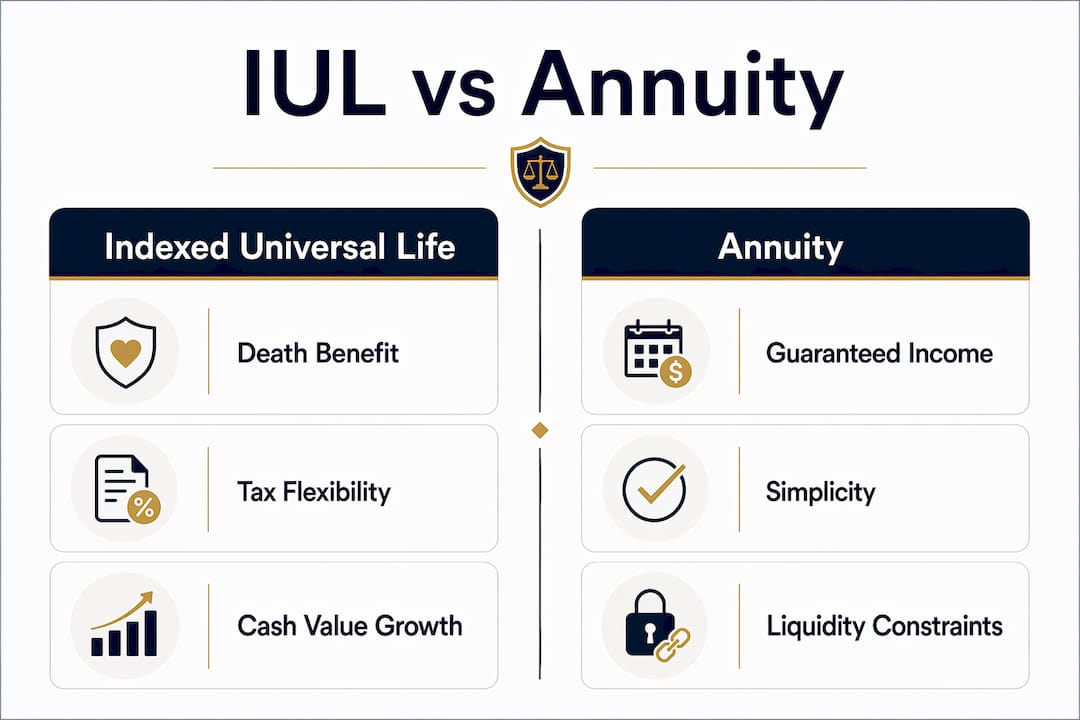
One sentence that captures the split: annuities win on guaranteed income and simplicity; IULs win on death benefit, flexible access, and tax-free loan potential.

| Dimension | IUL | Fixed Indexed Annuity (FIA) |
|---|---|---|
| Primary purpose | Death benefit + tax-advantaged cash value | Guaranteed retirement income |
| Growth potential | Index-linked, capped; limited by COI drag | Index-linked, capped; no COI drag |
| Downside protection | 0% floor on index crediting | 0% floor on index crediting |
| Tax treatment | Tax-deferred growth; loans typically tax-free | Tax-deferred growth; distributions taxed as ordinary income |
| Liquidity & access | Policy loans and withdrawals; lapse risk if unmanaged | Surrender periods 6–10 years; 10% free withdrawal typical |
| Costs & fees | COI, admin fees, rider charges | Spreads/caps, GLWB rider fees, surrender charges |
| Complexity | High; requires active monitoring | Moderate; simpler once in force |
| Ideal use case | Life insurance need + tax diversification + legacy | Essential income floor; longevity protection |
Where the two products look most similar is the FIA vs IUL comparison: both use index-linked crediting with a 0% floor. The critical difference is that FIAs leave more credited interest inside the contract because they do not deduct COI. Over a 20-year accumulation period, that cost difference compounds meaningfully.
The framing that practitioners use is worth keeping in mind: IULs address the risk of dying too soon (the death benefit protects your family), while annuities address the risk of living too long (guaranteed income you cannot outlive). Those are genuinely different problems, which is why many retirement plans end up using both.
How taxes and death benefits actually differ between the two
Tax treatment is where the IUL vs annuity decision gets complicated, and where mistakes are most costly.
IUL tax mechanics:
- Cash value grows tax-deferred inside the policy.
- Policy loans are generally income-tax-free, provided the policy remains in force and is not classified as a MEC.
- Withdrawals up to your cost basis (premiums paid) are tax-free; amounts above that are taxable as ordinary income.
- If the policy lapses with an outstanding loan balance, the entire loan amount becomes taxable income in that year, potentially at a high marginal rate.
The MEC risk: The IRS 7-pay test limits how quickly you can fund an IUL. If cumulative premiums in the first seven years exceed the 7-pay threshold, the policy becomes a Modified Endowment Contract. Once that happens, distributions follow LIFO (last-in, first-out) tax treatment, meaning earnings come out first and are taxable. Loans from a MEC are also taxable, and owners under 59½ face an additional 10% penalty.
Tax callout: A policy lapse with an outstanding loan balance can trigger a large, unexpected tax bill in a single year. MEC status compounds that risk by removing the tax-free loan advantage entirely.
Annuity tax mechanics:
- Earnings grow tax-deferred.
- Distributions are taxed as ordinary income on the gain portion (not the return of premium).
- For non-qualified annuities, the exclusion ratio determines the tax-free share of each payment.
- Qualified annuities (funded with pre-tax dollars from a rollover, for example) are fully taxable on distribution.
Death benefit contrast: An IUL death benefit passes to beneficiaries income-tax-free under IRC Section 101(a), which is one of the most powerful features of the product. Annuity death benefits are treated differently: the gain portion is taxable to the beneficiary as ordinary income, though some annuities offer enhanced death benefit riders. For estate planning purposes, the IUL’s income-tax-free death benefit is a significant structural advantage over a typical annuity payout. Readers focused on legacy planning will find this distinction particularly relevant.
What actually eats your returns: costs, fees, and common pitfalls
Both products can underperform their illustrations, and the reasons are predictable once you know where to look.
IUL cost drivers:
- COI charges that rise with age and accelerate in the later policy years
- Administrative and policy fees (often a flat monthly charge plus a percentage of premium)
- Rider charges for features like overloan protection, chronic illness, or return-of-premium
- Surrender charges in the early years if you need to exit the policy
Annuity cost drivers:
- Spreads and caps in FIAs that limit credited interest
- GLWB rider fees, often a small annual percentage of the benefit base, charged even in years with no market gain
- Subaccount management fees in variable annuities, which can stack to 2–3% or more annually
- Surrender charges for early withdrawals beyond the free-withdrawal provision
Common pitfalls for IULs:
- Overfunding relative to the 7-pay limit, triggering MEC status
- Taking loans without tracking the outstanding balance against projected cash value, which can cause a lapse
- Relying on illustrations that assume current caps hold for 30 years when insurers can and do reduce them
- Ignoring COI projections at older ages, where charges can spike sharply
Common pitfalls for annuities:
- Locking into a long surrender period without accounting for liquidity needs
- Adding multiple riders whose combined fees erode the account faster than the index credits it
- Assuming a GLWB rider guarantees account value (it guarantees income, not the account balance)
Pro Tip: To stress-test any illustration, ask the producer to run it with the cap 2 percentage points lower than currently illustrated, COI at the maximum contractual rate (for IULs), and a surrender scenario at year 5. If the numbers still work, the design has room to breathe. If they collapse, you are looking at a proposal built on optimistic assumptions.
When does each product make sense for you?
The right product depends on your age, income needs, health, and whether you need a death benefit at all. Here are the scenarios where each typically fits:
- Younger saver (35–50), needs life insurance: An IUL makes sense when you need permanent coverage and want the cash value to grow tax-deferred for future use. The COI is low at younger ages, so more premium goes to work in the cash value.
- Pre-retiree (55–65), needs guaranteed income for essential expenses: A fixed or fixed indexed annuity is usually the better tool. You want to know that rent, utilities, and healthcare are covered regardless of market performance.
- Retiree needing predictable lifetime income: A SPIA or a deferred annuity with a GLWB rider addresses longevity risk directly. No IUL illustration can match the certainty of a contractually guaranteed income stream.
- High-income earner seeking tax diversification and legacy: An IUL adds a tax-free income source (via loans) that complements taxable 401(k) distributions and leaves an income-tax-free death benefit for heirs. For additional practitioner perspective on supplemental income strategies, this use case is well-documented.
- Retiree with both income and legacy goals: Using both products together is often the most practical answer. An annuity covers the income floor; an IUL handles flexible access and the death benefit.
The general rule: if you do not need a death benefit and your primary goal is guaranteed income, an annuity is simpler and often more cost-effective. If you need life insurance and want tax-advantaged flexibility, an IUL earns its complexity.
How the Dual Purpose Retirement Strategy™ combines both products
The core idea behind Progressiveplanner’s Dual Purpose Retirement Strategy™ is straightforward: split your savings so that the same pool of money creates two distinct tax-advantaged streams, one guaranteed and one flexible, rather than concentrating everything in a single vehicle like a 401(k).
In practice, a portion of savings funds an annuity to create a guaranteed income floor, while another portion funds an IUL to build a tax-advantaged cash reserve with a death benefit. Financial planners who use combined strategies typically allocate the annuity to cover non-negotiable expenses and use the IUL for discretionary spending and legacy.
Compact case example (illustrative round numbers):
| Allocation | Product | Purpose | Projected outcome |
|---|---|---|---|
| — | Fixed indexed annuity with GLWB | Essential income floor | Guaranteed income for life, starting at retirement |
| — | IUL (funded over 10 years) | Flexible cash value + death benefit | Tax-advantaged loans for discretionary use; income-tax-free death benefit for heirs |
| Combined | Dual Purpose structure | Two income streams from same savings | Covers essentials + preserves legacy without depleting a single account |
Note: These are illustrative figures only. Actual outcomes depend on age, health, carrier terms, and market conditions.
Running both products together requires ongoing attention:
- Monitor IUL loan balances against projected cash value annually to prevent lapse risk
- Review annuity rider fees each year to confirm the income guarantee still justifies the cost
- Assess insurer financial strength ratings (A.M. Best, S&P) for both the annuity carrier and the IUL carrier, since both products depend on insurer solvency
- Revisit the allocation if income needs or estate goals change significantly
Questions to ask an advisor before you sign anything
Most problems with IULs and annuities trace back to proposals that were never stress-tested. These questions put the burden of proof where it belongs.
Questions for an IUL proposal:
- What cap and participation rate is this illustration using, and what is the current contractual maximum the carrier can lower it to?
- Show me the COI schedule at age 75, 80, and 85. What happens to cash value if I live to 90?
- What is the 7-pay limit for this policy, and how does the proposed premium compare to it?
- If I take loans at the illustrated rate, at what point does the policy lapse under a stress scenario?
- What is the surrender schedule, and what do I receive if I exit in year 3 or year 5?
Questions for an annuity proposal:
- What is the total annual cost of all riders combined, and what does each one actually guarantee?
- What is the surrender period and the free-withdrawal provision?
- What is the carrier’s A.M. Best rating, and how long has it held that rating?
- For a GLWB rider: what is the benefit base, the withdrawal percentage, and does the income step up if I delay?
- Is this a qualified or non-qualified annuity, and how does that affect my tax situation?
Red flags to watch for:
- Illustrations that assume the current cap rate holds for 20–30 years with no reduction
- Vague or missing COI projections for older ages
- A producer pushing rapid premium funding without discussing the 7-pay test
- Promises of “guaranteed high returns” (no indexed product can guarantee a specific return)
- Missing MEC analysis in the IUL proposal
Documents to bring to the meeting: recent retirement account statements, a written income needs schedule (essential vs. discretionary), current life insurance coverage details, and any health information relevant to underwriting.
Key Takeaways
An annuity covers the income risk you cannot afford to get wrong; an IUL covers the death-benefit and tax-flexibility needs that a guaranteed income stream cannot address, and combining both under a structured strategy is often the most complete retirement solution.
| Point | Details |
|---|---|
| Annuity for income certainty | Annuities provide guaranteed lifetime income that IULs cannot contractually replicate. |
| IUL for death benefit and tax-free loans | IUL death benefits pass income-tax-free to heirs; policy loans are tax-free when the policy stays in force. |
| MEC risk is the biggest IUL pitfall | Exceeding the IRS 7-pay limit converts an IUL to a MEC, eliminating the tax-free loan advantage. |
| COI drag vs. no COI in FIAs | Fixed indexed annuities credit more net interest than IULs because they carry no cost-of-insurance charge. |
| Progressiveplanner’s Dual Purpose Strategy™ | Splits savings between an annuity income floor and an IUL cash reserve to create two tax-advantaged streams from the same dollars. |
The case for not choosing just one
Most articles on this topic frame IUL vs annuity as a binary decision, and that framing does a disservice to anyone with more than one retirement goal. The honest answer is that these products solve different problems, and treating them as competitors misses the point.
An annuity is a longevity hedge. It answers the question: what if I live to 95 and run out of money? An IUL is a death-benefit vehicle with a tax-advantaged savings component attached. It answers: what if I die before I spend everything, and what if I need flexible, tax-efficient income in retirement? Those are not the same question.
Where I think conventional advice goes wrong is in treating complexity as a reason to avoid IULs entirely. Yes, they require active management. Yes, a poorly designed policy with aggressive loan assumptions can lapse at the worst possible time. But the answer to that is better design and stress-testing, not avoidance. A well-structured IUL, funded conservatively and monitored annually, does something no annuity can: it leaves an income-tax-free death benefit while also providing flexible, tax-free access during your lifetime.
The Dual Purpose approach that Progressiveplanner uses is not a gimmick. It is a recognition that covering essential expenses with guaranteed income and preserving flexibility with an IUL is simply better risk allocation than putting everything in one bucket. The caveat is that it only works if both products are designed conservatively and reviewed regularly with a licensed advisor who will show you the stress-test scenarios, not just the optimistic ones.
What a Progressiveplanner consultation actually looks like
Progressiveplanner’s Dual Purpose Retirement Strategy™ is built around one core idea: the same savings dollar should not have to choose between guaranteed income and tax-advantaged flexibility. A consultation walks you through a side-by-side income comparison showing what your current retirement savings could produce under a traditional single-bucket approach versus a split allocation across an annuity and an IUL.

The review covers a MEC check on any proposed IUL design, an insurer financial-strength assessment for both carriers, and a personalized allocation suggestion based on your income needs, health profile, and legacy goals. You leave with a clear picture of what each product guarantees, what it costs, and how the two work together under conservative assumptions. To request a free retirement income review, visit Progressiveplanner’s site and schedule a consultation with a licensed advisor.
Useful sources and further reading
- IUL vs. Annuity | MoneyGeek: Covers core product differences, indexing mechanics, and cost structures for both IULs and annuities.
- IUL vs. Annuities: Settling the Debate | InsuranceNewsNet: Practitioner framing of the “dying too soon vs. living too long” risk distinction and combined-strategy rationale.
- Modified Endowment Contract (MEC) | Western & Southern: Authoritative explanation of the IRS 7-pay test, MEC classification, and tax consequences.
- IUL vs Annuity | SmartAsset: Plain-language breakdown of tax treatment differences, loan mechanics, and distribution rules.
- IUL vs. Annuity | Gainbridge: Detailed comparison of cost structures, including why FIAs typically net more credited interest than IULs.
- NAIC Life Insurance Resources | NAIC: The National Association of Insurance Commissioners’ reference on life insurance regulation and consumer protections.
- Annuities vs. Life Insurance | III: The Insurance Information Institute’s overview of how annuities and life insurance differ structurally and in purpose.
- Progressiveplanner — Dual Purpose Retirement Strategy™: The publisher’s modeling tools, consultation offer, and explanation of how IUL and annuity allocations are combined in practice.
This article is general educational information, not personalized financial or tax advice. Consult a licensed financial advisor and a tax professional to evaluate how these products apply to your specific situation.