
Tax-Free Retirement Income: Your Multi-Account Strategy

Tax-free retirement income means structuring your withdrawals so you never hand the IRS a cut of money you already earned. Not every dollar has to be taxed twice. The accounts you use, the order you tap them, and the conversions you make years before retirement all determine whether your distributions add to your taxable income or disappear from it entirely. Here is what actually matters:
- Roth IRAs and Roth 401(k)s grow and distribute tax-free after age 59½, provided the account has been open at least five years.
- Health Savings Accounts (HSAs) offer triple tax advantages: deductible contributions, tax-deferred growth, and tax-free withdrawals for qualified medical expenses.
- Traditional 401(k)s and IRAs defer taxes until withdrawal, which creates a future liability that grows with the account balance.
- Indexed Universal Life (IUL) insurance builds cash value that you can access through policy loans without triggering income recognition, as long as the policy is not classified as a Modified Endowment Contract under IRS rules.
The hidden danger in relying too heavily on tax-deferred accounts is bracket creep. A $50,000 traditional IRA withdrawal does not just get taxed on its own. It pushes more of your Social Security into taxable territory and can trigger Medicare IRMAA surcharges. Pull that same amount from a Roth, and your adjusted gross income stays flat.
Table of Contents
- Key strategies to minimize taxes on retirement income
- How asset location shapes your after-tax returns
- The Dual Purpose Retirement Strategy™ and how IUL changes the math
- Key Takeaways
- What a personalized retirement income review can show you
Key strategies to minimize taxes on retirement income
The three-bucket framework — taxable, tax-deferred, and tax-free accounts — gives retirees the architecture to control which income gets taxed and when. The sequence you follow matters more than most people realize.
- Taxable accounts first. Long-term capital gains for married couples filing jointly are taxed at 0% when taxable income stays under a certain threshold in 2026. Spending from a brokerage account holding dividend ETFs within that threshold costs nothing in federal tax.
- Roth accounts second. Qualified Roth distributions do not count as income for Social Security taxation thresholds or IRMAA calculations. They are genuinely invisible to the IRS.
- Tax-deferred accounts last. Keep traditional 401(k) and IRA withdrawals small enough to stay within the standard deduction, which is more generous for couples both over 65 before a single dollar of federal income tax applies.
The RMD torpedo is the trap most retirees walk into. The IRS requires distributions from traditional accounts starting at age 73, and a large balance means large mandatory withdrawals that push brackets higher and inflate Medicare premiums. The fix is converting balances before RMDs begin.
Roth conversions work best in the gap years between retirement and Social Security or RMD onset, when income temporarily drops. Converting amounts from a traditional IRA into a Roth during a low-income window locks in today’s lower rate and permanently shrinks the future RMD balance.
Pro Tip: Size each Roth conversion to fill your current bracket without crossing into the next one. Crossing key tax bracket boundaries or triggering IRMAA surcharges at certain income levels for joint filers can cost more in surcharges than the conversion saves.
HSAs deserve a dedicated mention. Most high earners treat them as a pass-through for current medical bills. The smarter play is paying medical expenses out of pocket now, saving every receipt, and withdrawing HSA funds in retirement tax-free against years of stockpiled qualified expenses. That turns an HSA into a stealth tax-free income source.
How asset location shapes your after-tax returns
Asset location is not the same as asset allocation. Allocation decides what you own. Location decides where you hold it, and that choice compounds over decades.
Vanguard identifies asset location as a second major lever for tax efficiency beyond allocation alone. The principle is straightforward: income-generating assets belong inside tax-advantaged accounts, and tax-efficient investments belong in taxable accounts.
- Inside tax-deferred or tax-free accounts: bonds, REITs, dividend-heavy funds, and any asset generating ordinary income. These would otherwise create annual taxable events.
- Inside taxable accounts: broad index funds, ETFs with low turnover, and municipal bonds. Index funds rarely trigger capital gains distributions, and municipal bond interest is federally tax-exempt.
- IUL policies: the cash value grows without annual tax reporting, making them a natural complement to a diversified, tax-optimized portfolio.
Poor asset location is one of the most common sources of unnecessary tax drag. A bond fund sitting in a taxable brokerage generates interest income taxed at ordinary rates every year. Move it inside a traditional IRA, and that same income compounds without annual taxation. The difference over a 20-year retirement is not trivial in dollar terms, even if the investment returns are identical.
The Dual Purpose Retirement Strategy™ and how IUL changes the math

Indexed Universal Life insurance is a permanent life insurance policy whose cash value grows based on a market index, typically with a floor that prevents losses in down years. The growth is not directly invested in the market, so the floor protection is real. Policy loans against that cash value do not count as taxable income under IRS rules, as long as the policy avoids MEC status.
Progressiveplanner’s Dual Purpose Retirement Strategy™ takes this a step further. The same dollar that funds an IUL policy serves two functions simultaneously: building cash value for tax-free retirement income and maintaining a death benefit for heirs. That dual function is what separates it from a standard Roth or 401(k), where the dollar does one job.
| Feature | Traditional 401(k) / IRA | Roth IRA | IUL via Dual Purpose Strategy™ |
|---|---|---|---|
| Contributions | Pre-tax | After-tax | After-tax (insurance premiums) |
| Growth taxation | Tax-deferred | Tax-free | Tax-deferred inside policy |
| Withdrawals | Taxable as ordinary income | Tax-free (qualified) | Tax-free via policy loans |
| RMD requirement | Yes, starting at age 73 | No (Roth IRA) | No |
| Death benefit | None | None | Yes |
| Downside protection | Market-dependent | Market-dependent | Floor protection on index |
The strategy directly addresses three retirement tax traps: the RMD torpedo, Social Security taxation thresholds, and Medicare IRMAA surcharges. Because IUL policy loans do not appear as income, they leave your MAGI untouched. That means Social Security stays below the 85% taxation threshold, and Medicare premiums stay at the base tier, even when you are drawing significant income.
The risks are real and worth naming. IUL policies carry internal costs — cost of insurance, administrative fees, and surrender charges in early years — that reduce net returns compared to a pure investment account. A policy that lapses due to underfunding can trigger a taxable event on all accumulated gains. And the tax-free loan treatment depends on the policy remaining in force and avoiding MEC classification. These are not reasons to avoid IUL, but they are reasons to structure it carefully with a qualified advisor rather than treating it as a set-and-forget account.
For retirees who want to learn how life insurance can generate retirement income, the mechanics of policy loans and cash value access are worth understanding before committing to any strategy.
Key Takeaways
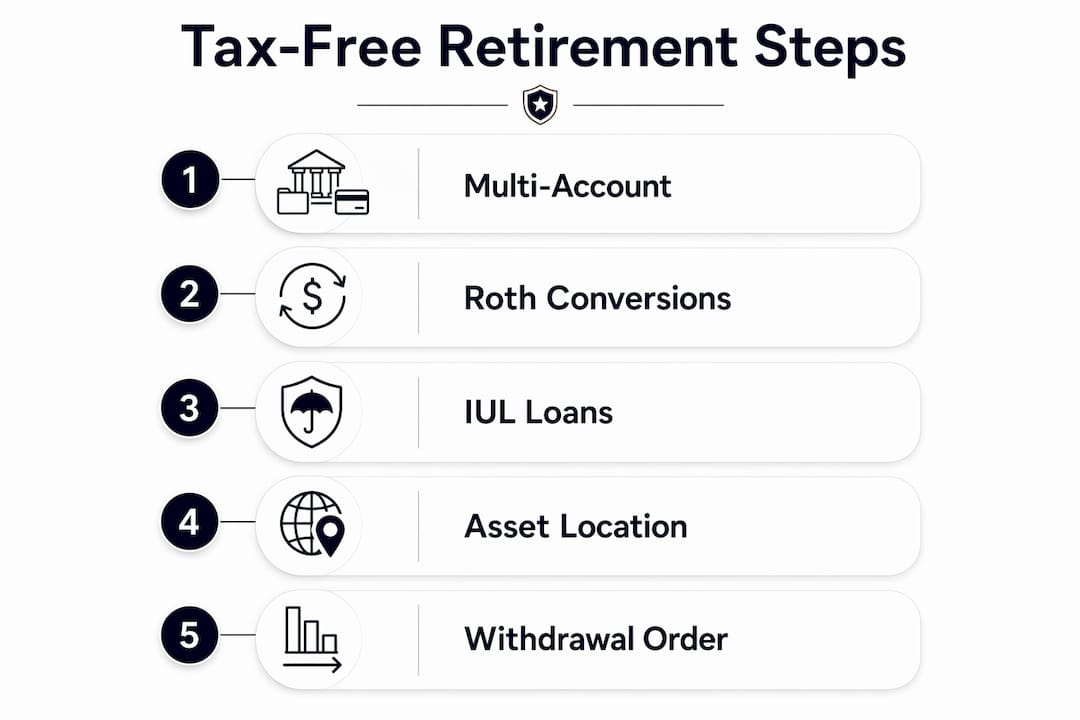
Multi-account coordination, Roth conversions timed to low-income years, and IUL policy loans are the three levers that together can produce genuinely tax-free retirement income without triggering Social Security taxation or Medicare surcharges.
| Point | Details |
|---|---|
| Withdrawal sequence matters | Tap taxable accounts first, Roth second, and tax-deferred last to minimize federal tax exposure. |
| Roth conversions reduce RMD risk | Converting before age 73 shrinks the balance subject to mandatory distributions and future bracket creep. |
| Asset location compounds savings | Placing income-generating assets in tax-advantaged accounts eliminates annual tax drag over decades. |
| IUL loans are income-invisible | Policy loans from a properly structured IUL do not count as income, preserving Social Security and Medicare thresholds. |
| Progressiveplanner’s Dual Purpose Strategy™ | Creates two tax-advantaged income streams from the same dollar, combining IUL cash value with traditional account coordination. |
What a personalized retirement income review can show you
Most retirement projections show you one income stream. Progressiveplanner shows you two from the same savings, using the Dual Purpose Retirement Strategy™ to pair an IUL policy with your existing 401(k) or IRA so that each dollar works harder than it would in a single account.

The gap between a traditional retirement plan and a coordinated multi-account strategy often runs into tens of thousands of dollars in avoided taxes over a 20-year retirement. Progressiveplanner’s advisors run a personalized income comparison that maps your current accounts, projects your RMD exposure, and shows exactly where IUL fits into your specific tax picture. If you have an existing 401(k), IRA, or high income and want to see what a tax-advantaged retirement strategy built around your numbers actually looks like, a free retirement income review is the concrete next step.